Rep. Terri Leo Wilson (R) HD-23 filed House Bill 1198 (Texas Legislature Online) on Nov. 17, 2026. The bill would amend Tax Code Section 11.351 so a temporary exemption that applies when an improvement to a residence homestead is completely destroyed by fire would also apply when such an improvement is completely destroyed by a flood or windstorm. The bill would take effect Jan. 1, 2028, only if voters approve a related constitutional amendment.
What the Bill Would Change
HB 1198 would change the heading of Tax Code Section 11.351 to "Temporary Exemption for Improvement to Residence Homestead Destroyed by Fire, Flood, or Windstorm." It would amend subsections (b), (c), (d) and (e) of that section so each reference that now covers destruction by fire would also cover destruction by flood or windstorm.
Under the amended section, a person would be entitled to an exemption from taxation by a taxing unit, in an amount set out in subsection (d), of the appraised value of an improvement to the person's residence homestead that:
- is completely destroyed by a fire, flood, or windstorm
- is a habitable dwelling immediately before the date the fire, flood, or windstorm occurs
- remains uninhabitable for at least 30 days after that date
The exemption would apply only for the tax year in which the fire, flood, or windstorm occurs. The amount would be calculated by multiplying the appraised value of the improvement for that tax year by a fraction. The denominator would be 365. The numerator would be the number of days remaining in the tax year after the date on which the fire, flood, or windstorm occurs.
A property owner would have to submit an application to the chief appraiser of the appraisal district where the improvement is located not later than the 180th day after the date the fire, flood, or windstorm occurs.
The change in law would apply only to an ad valorem tax year that begins on or after the bill's effective date. The Act would take effect Jan. 1, 2028, but only if the constitutional amendment proposed by the 90th Legislature, Regular Session, 2027, to authorize the Legislature to provide for a temporary exemption for a homestead improvement completely destroyed by a flood or windstorm is approved by the voters. If that amendment is not approved, the Act would have no effect.
The Related Constitutional Amendment
Leo Wilson also filed House Joint Resolution 79 (Texas Legislature Online) on Nov. 17, 2026. Its caption is, "Proposing a constitutional amendment to authorize the legislature to provide for a temporary exemption from ad valorem taxation of the appraised value of an improvement to a residence homestead that is completely destroyed by a flood or windstorm."
HJR 79 would amend Section 1-b(z), Article VIII, of the Texas Constitution. Under the amended subsection, the Legislature by general law may provide for a temporary exemption from ad valorem taxation of the appraised value of an improvement to a person's residence homestead that is completely destroyed by a fire, flood, or windstorm. The Legislature by general law may prescribe the duration of the exemption and may provide additional eligibility requirements.
If the Legislature adopts HJR 79, the proposed amendment would be submitted to voters at an election on Nov. 2, 2027. The ballot would be printed to permit voting for or against the proposition: "The constitutional amendment to authorize the legislature to provide for a temporary exemption from ad valorem taxation of the appraised value of an improvement to a residence homestead that is completely destroyed by a flood or windstorm."
Why It Reaches Rural Texas
The exemption would apply to an improvement to a residence homestead that meets the bill's tests, wherever that homestead sits in Texas, including rural areas. Leo Wilson's Texas House member page lists Chambers County and part of Galveston County as the counties she represents. Those coastal counties are exposed to flooding and windstorms, and the bill's text is statewide.
Where It Stands
HB 1198 and HJR 79 have been filed and have not been referred to a committee. Neither has a fiscal note posted yet. The 90th Legislature convenes Jan. 12, 2027. Leo Wilson is the only author listed on both measures.
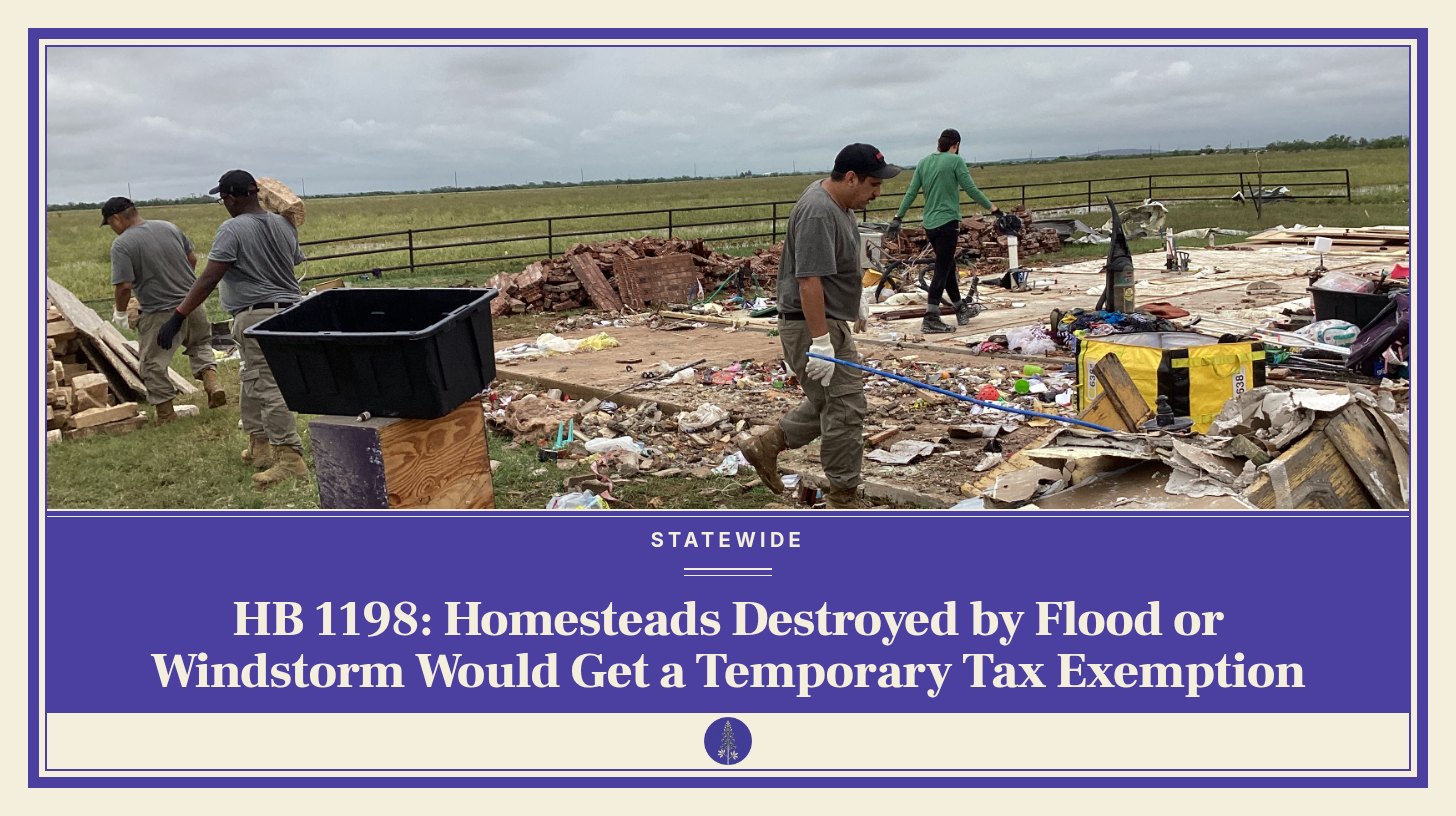
Header photo: A home east of Hawley in Jones County, West Texas, after it was swept away in a tornado rated at high end EF3 intensity, May 6, 2024. National Weather Service photo, public domain, via Wikimedia Commons.
Sources
- HB 1198 bill history, 90th Legislature
- HB 1198 bill text, as filed
- HB 1198 authors
- HJR 79 bill history, 90th Legislature
- HJR 79 text, as filed
- HJR 79 authors
- Rep. Terri Leo Wilson, House District 23
- Legislative Reference Library member profile, Terri Leo Wilson
- Government Code Section 301.001 (session start)