Rep. Brooks Landgraf (R) HD-81 filed House Bill 717 (Texas Legislature Online) on Nov. 9, 2026. The bill would amend Local Government Code Section 130.914, the rural ambulance service grant program. Under current law, a "qualified county" is a county that has a population of 68,750 or less. HB 717 would change that figure to 200,000 or less. HB 717 has been filed and has not become law.
The comptroller shall establish and administer the program to support the state purpose of ensuring adequate ground ambulance services by providing financial assistance to qualified rural ambulance service providers in qualified counties. The official statute text records that the section was added by House Bill 3000 in 2025 and took effect Sept. 1, 2025.
Who Could Receive a Grant
The statute defines an "ambulance" as a vehicle registered with the Department of State Health Services as an emergency medical service provider vehicle. A "qualified rural ambulance service provider" means a private safety entity or public agency, as those terms are defined by Health and Safety Code Section 772.001, that is licensed by the Department of State Health Services to provide emergency medical services and is operating predominantly in a qualified county. Section 772.001 defines a "private safety entity" as a private entity that provides emergency fire-fighting, ambulance, or medical services. It defines a "public agency" as a municipality or county in this state that provides or has authority to provide fire-fighting, law enforcement, ambulance, medical, or other emergency services.
Grant Amounts
The comptroller may award a grant under the section only in the following applicable amount:
- For a county with a population of less than 10,000, an amount not to exceed $500,000.
- For a county with a population between 10,000 and 68,750, an amount not to exceed $350,000.
HB 717 would change the second of those ranges from "between 10,000 and 68,750" to "between 10,000 and 200,000." The first range and the $500,000 and $350,000 figures would be unchanged.
How the Program Works
Not later than the 30th day after the first day of a qualified county's fiscal year, the county, on behalf of a qualified rural ambulance service provider, may submit a grant application to the comptroller. A county may submit only one application each fiscal year. If a county is awarded a grant under the program for a qualified rural ambulance service provider, the provider is ineligible to receive additional grant funds under the program from another qualified county in the same fiscal year.
The comptroller may award a grant to a qualified county using money appropriated to the comptroller for that purpose and only in accordance with a written agreement between the comptroller and the county that includes conditions providing the comptroller with sufficient control to ensure the public purpose of providing adequate ground ambulance services is accomplished. In awarding grants, the comptroller shall consider the county's ability to otherwise obtain the money necessary to provide adequate ground ambulance services, including considering for the county the average per capita taxable property value, per capita income, and unemployment rate.
A qualified county awarded a grant may use or authorize the use of the grant money only to purchase ambulances, including necessary accessories and modifications, as provided by comptroller rule. A qualified county awarded a grant may not reduce the budget of the qualified rural ambulance service provider for the county's next fiscal year following the fiscal year of the grant award.
The comptroller may disburse a grant award to a qualified county before the county places an order for an ambulance. The county shall purchase and take possession of an ambulance with money awarded under the program not later than the fifth anniversary of the date the county receives the money. Until an ambulance becomes available for purchase, the county may deposit the grant funds in an interest bearing account and may treat any resulting proceeds as grant funds under the program. The comptroller shall adopt rules necessary to implement the section, including rules to establish a standardized application process, deadlines for applying, disbursing, and spending grant money, and procedures for monitoring the disbursement of grant money and for requiring the return of grant money if a county fails to use the money for a purpose authorized by the section.
Where It Stands
HB 717 has not been referred to a committee. Texas Legislature Online lists Landgraf as the only author and shows no companion bill. The bill would take effect Sept. 1, 2027. The 90th Legislature convenes Jan. 12, 2027. Landgraf's House District 81 covers Ector, Loving, Ward, and Winkler counties.
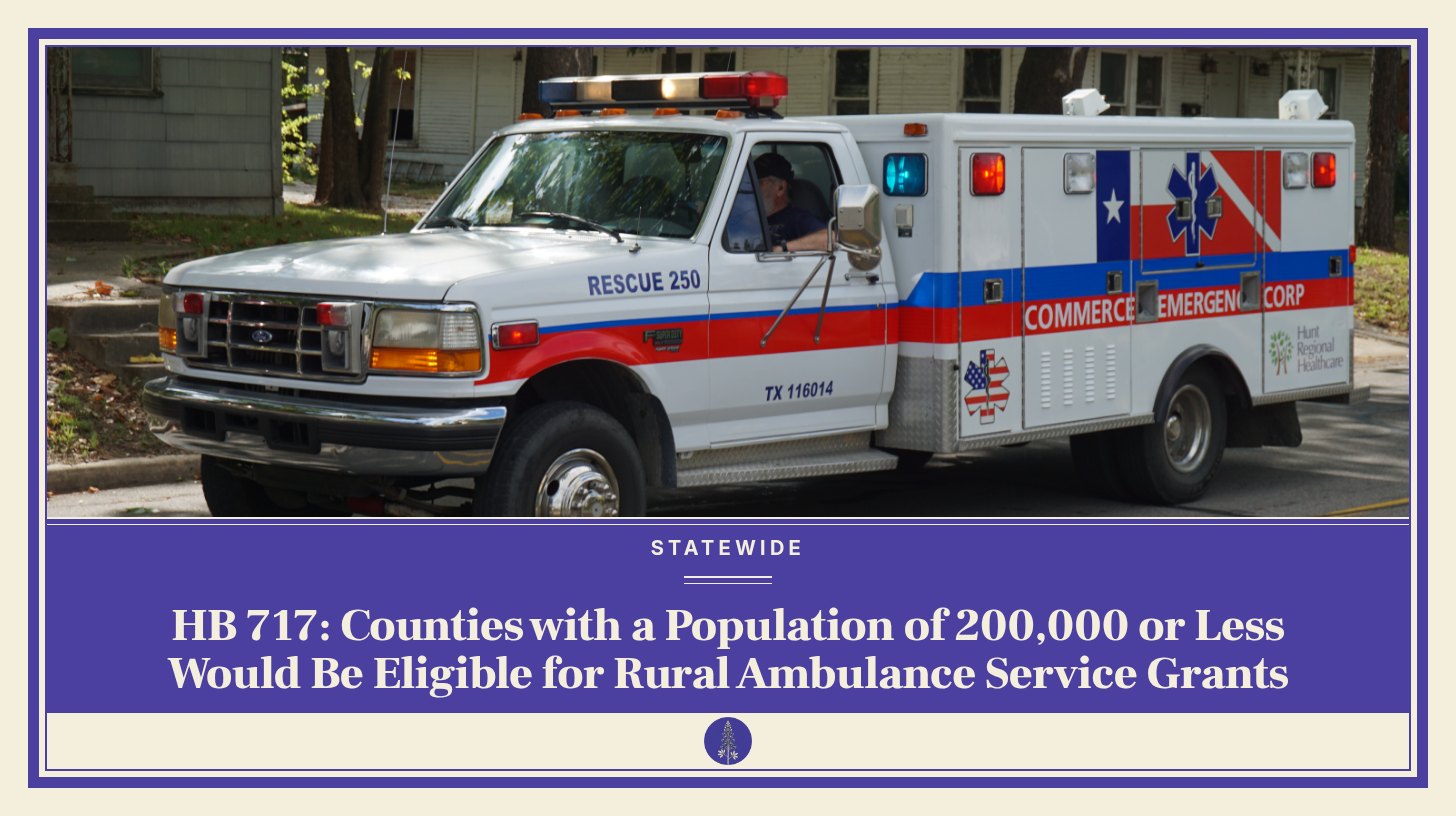
Header photo: A Commerce Emergency Corps rescue vehicle at the 31st Annual Bois d'Arc Bash in Commerce, Texas, Sept. 24, 2016. Photo by Michael Barera, CC BY-SA 4.0, via Wikimedia Commons.
Sources
- HB 717 bill history, 90th Legislature
- HB 717 bill text, as filed
- HB 717 authors
- HB 717 companions
- Rep. Brooks Landgraf, House District 81
- Legislative Directory member page, Representative Brooks Landgraf
- Texas Secretary of State election results, Nov. 3, 2026 general election
- Local Government Code Section 130.914, rural ambulance service grant program
- Health and Safety Code Section 772.001, definitions
- Government Code Section 301.001 (session start)