Sen. Judith Zaffirini (D) SD-21 filed Senate Bill 34 (Texas Legislature Online) on Nov. 9, 2026. The bill would add Subchapter N, "County Regulation of Large-Load Electricity Users," to Local Government Code Chapter 231. Section 231.302 says the subchapter "applies only to the unincorporated area of a county." SB 34 has been filed and has not become law.
Who Would Be Covered
The bill would define a "large computational load facility" as a tract, or one or more contiguous or noncontiguous tracts of land under common ownership or control, that are developed or proposed for development for use by a large computational load.
A "large computational load" would mean a business that is primarily engaged in creating, executing, and delivering software applications and services; artificial intelligence training, deployment, and delivery; adding virtual currency transactions to a distributed ledger; or other computational activities at a data center; and that is a large load under Utilities Code Section 37.0561. The definition also refers to a substation, transmission or distribution facilities, or other electric infrastructure designed to serve the facility or project. In determining whether a facility or project meets the Section 37.0561 test, the county may aggregate related facilities, phases, contiguous or noncontiguous tracts, meters, or projects that are under common ownership or control or are developed, financed, constructed, or operated as part of a common plan.
Current Utilities Code Section 37.0561, which the bill cites, provides that a large load customer includes an entity requesting an interconnection that exceeds a demand threshold adopted by the Public Utility Commission of Texas. That section directs the commission to establish a demand threshold of 75 megawatts unless the commission determines that a lower threshold is necessary.
A "project" would include the construction of a new large computational load or a material expansion, redevelopment, or change in the use of an existing facility. A material expansion is an increase in electricity demand of at least 10 megawatts.
Zoning Districts
The bill says that, to protect the public health, safety, and welfare, promote the orderly development of the county, and ensure that county residents benefit from large computational load development, a commissioners court may establish one or more county large computational load zoning districts and regulate the location and development of large computational load within a district, consistent with the subchapter.
A district may include all or part of the unincorporated area of the county. The boundaries would have to be described by metes and bounds or shown on a map adopted as part of the order establishing the district. A zoning district or district boundary would not be effective until adopted by the commissioners court after a public hearing. Before adopting a district or boundary, the court would have to provide public notice and hold a public hearing in accordance with procedures adopted by the court.
After the court provides notice of a hearing to establish or amend a district, a person may not begin construction or development of, or materially expand, redevelop, or materially change the use of, a county large computational load facility within the area described in the notice until the court adopts or rejects the proposal, or fails to take action before the 91st day after the date notice is provided.
What a County Could Regulate
The commissioners court may adopt reasonable zoning regulations within a district governing county large computational load facilities and large computational load, including regulations addressing:
- the location of a facility
- minimum lot size and tract dimensions
- setbacks, buffers, landscaping, screening, and open-space requirements
- measures reasonably necessary to protect nearby residential, educational, medical, agricultural, or environmentally sensitive uses from incompatible development
- access roads, traffic mitigation, emergency access, and transportation impacts
- noise, vibration, exterior lighting, and other off-site impacts
- water supply, water conservation, cooling technology, wastewater service, stormwater management, drainage, floodplain management, and land subsidence risks, as applicable
- fire protection, emergency response, law enforcement, and other public safety considerations
- improvements, mitigation measures, capacity requirements, and service arrangements necessary to address project-related demands on county roads, bridges, drainage and flood-mitigation infrastructure, facilities, services, and county infrastructure capacity
- disclosure of information necessary for the county to evaluate impacts on public infrastructure, water resources, emergency services, public safety, and county finances, subject to Government Code Chapter 552
- reasonable mitigation measures, road-use agreements, infrastructure agreements, and cost-sharing agreements reasonably related to project impacts and necessary to ensure that project-related county infrastructure, mitigation, remediation, and service costs are borne by the project rather than county taxpayers
- performance bonds, closure bonds, site-restoration commitments, and other financial assurances necessary to ensure compliance and address abandonment, prolonged inactivity, decommissioning, demolition, remediation, removal of equipment or hazardous materials, and final site restoration
- any other reasonable land-use regulation directly related to the public health, safety, or welfare or the orderly development of the county
A zoning regulation would have to be reasonably related to a documented or reasonably foreseeable impact of a large computational load and may not be arbitrary or unrelated to a purpose authorized by the subchapter. The county may determine the amount, form, duration, issuer, renewal requirements, and conditions for release of a performance bond, closure bond, letter of credit, or other financial assurance. The amount would have to be reasonably related to the anticipated cost of compliance, mitigation, remediation, decommissioning, or site restoration.
A county may not adopt regulations that directly conflict with a regulation adopted by a state agency.
Special Use Permits
The commissioners court may require a person to obtain a special use permit before developing, constructing, materially expanding, redeveloping, or materially changing a county large computational load facility within a district.
An application may require site plans and engineering studies; information on traffic, water supply, wastewater, drainage, floodplain, emergency service, public safety, and county infrastructure impacts; information on anticipated electric demand, energization schedules, load growth, and electric infrastructure associated with the project; identification of any proposed water source and information on the availability of an adequate long-term water supply; supporting documentation prepared or certified by a professional engineer licensed in Texas demonstrating that the proposed electric, water, wastewater, and other utility service and any required infrastructure improvements are reasonably capable of serving the projected demand without impairing existing service; documentation that the project has been submitted to any applicable review or interconnection process required by the Public Utility Commission of Texas or administered by the Electric Reliability Council of Texas or another entity with jurisdiction; and information reasonably necessary to identify and evaluate measures to mitigate documented adverse impacts within the county's authority under the subchapter.
Before acting on a permit, the court may provide public notice and may hold a public hearing. The county may determine whether an application is complete and may require additional information reasonably necessary to evaluate it. A permit application would not be considered filed until the county determines that the application is complete.
The court may approve, conditionally approve, or deny a special use permit based on compliance with the subchapter and zoning regulations adopted under it. A permit may be denied if the applicant fails to demonstrate compliance with applicable zoning regulations or fails to adequately address a documented or reasonably foreseeable impact within the county's authority. After notice and an opportunity to cure, the county may suspend or revoke a permit for a material violation of the subchapter, a zoning regulation, or a permit condition. The county may issue a stop-work order if construction or development is occurring without a required permit or in material violation of a zoning regulation or permit condition.
The court may impose reasonable application, inspection, administrative, and professional-review fees, including the reasonable cost of qualified consultants retained by the county, in an amount not to exceed the county's actual costs of administering the subchapter and reviewing the application.
Information submitted would be subject to Government Code Chapter 552. A county may not enter into an agreement requiring the county to withhold information from public disclosure except to the extent withholding is authorized by that chapter or other law.
Limits on County Authority
The subchapter would not authorize a county to regulate electric rates or electric service; water rates or water service; generation permitting; transmission or distribution facility siting or interconnection standards; or the operations of the Public Utility Commission of Texas or the Electric Reliability Council of Texas.
In evaluating a project, a county may request and consider information on anticipated electric demand, the timing and scale of load growth, planned substations, transmission or distribution facilities, or other electric infrastructure associated with the project, the status of any applicable review or interconnection process required or administered by the Public Utility Commission of Texas or the Electric Reliability Council of Texas, and measures proposed to reduce impacts on county infrastructure, emergency services, public safety, water supplies, and neighboring property.
The subchapter would have to be liberally construed to accomplish its purposes of protecting the public health, safety, and welfare; promoting the orderly development of each county; and protecting neighboring property and public infrastructure. It may not be construed to authorize a county to regulate electric rates, electric service, wholesale electric markets, electric reliability standards, or a matter assigned by state or federal law to the Public Utility Commission of Texas, the Electric Reliability Council of Texas, or a federal agency.
Existing Facilities and Plats
A county large computational load facility lawfully developed, or a large computational load lawfully operating, before the effective date of a zoning regulation adopted under the subchapter may continue as a lawful nonconforming use. Zoning regulations would apply to a material expansion, redevelopment, or change in use of a nonconforming facility or load. In evaluating that activity, the county may consider the cumulative impacts of the existing facility or load and the proposed activity.
A facility or load would not be entitled to nonconforming-use status solely because land has been purchased, a project has been announced, utility service has been requested, or a preliminary application has been submitted.
Notwithstanding Local Government Code Section 232.001(h), a county may require an applicant for a plat or replat of property located within a large computational load zoning district to submit information, analyses, studies, plans, agreements, and financial assurances authorized by the subchapter or regulations adopted under it. Current Section 232.001(h) says a county may not require an analysis, study, document, agreement, or similar requirement to be included in or as part of an application for a plat, development permit, or subdivision of land that is not explicitly required by state law.
Notwithstanding Section 232.0025, a plat or replat application for property in such a district would not be considered complete, and the period within which the commissioners court or county authority must approve, conditionally approve, or disapprove the application would not begin, until the county determines that the application includes the information required under the subchapter, regulations adopted under it, and Chapter 232, and any special use permit required for the development proposed in the application has been finally approved. Denial of a required special use permit would constitute grounds for disapproval of the plat or replat. Current Section 232.0025 generally requires a county to approve, approve with conditions, or disapprove a completed plat application not later than the 30th day after the completed application is received, with stated exceptions.
Enforcement and Where It Stands
A county may bring an action for injunctive relief to prevent or restrain a violation of the subchapter, a zoning regulation adopted under the subchapter, or a special use permit issued under the subchapter. A person who violates the subchapter, a zoning regulation, or a special use permit would be liable to the county for a civil penalty of not less than $500 or more than $10,000 for each violation for each day the violation continues. The county attorney or district attorney may bring the action in a district court in the county. A county that prevails may recover reasonable attorney's fees, court costs, investigative costs, and expert-witness fees.
SB 34 has not been referred to a committee. Texas Legislature Online lists Zaffirini as the only author and shows no companion bill. The bill would take effect Sept. 1, 2027. The 90th Legislature convenes Jan. 12, 2027. Zaffirini's Senate page says District 21 covers 16 counties, from Laredo to Starr County and north to Travis and Hays counties.
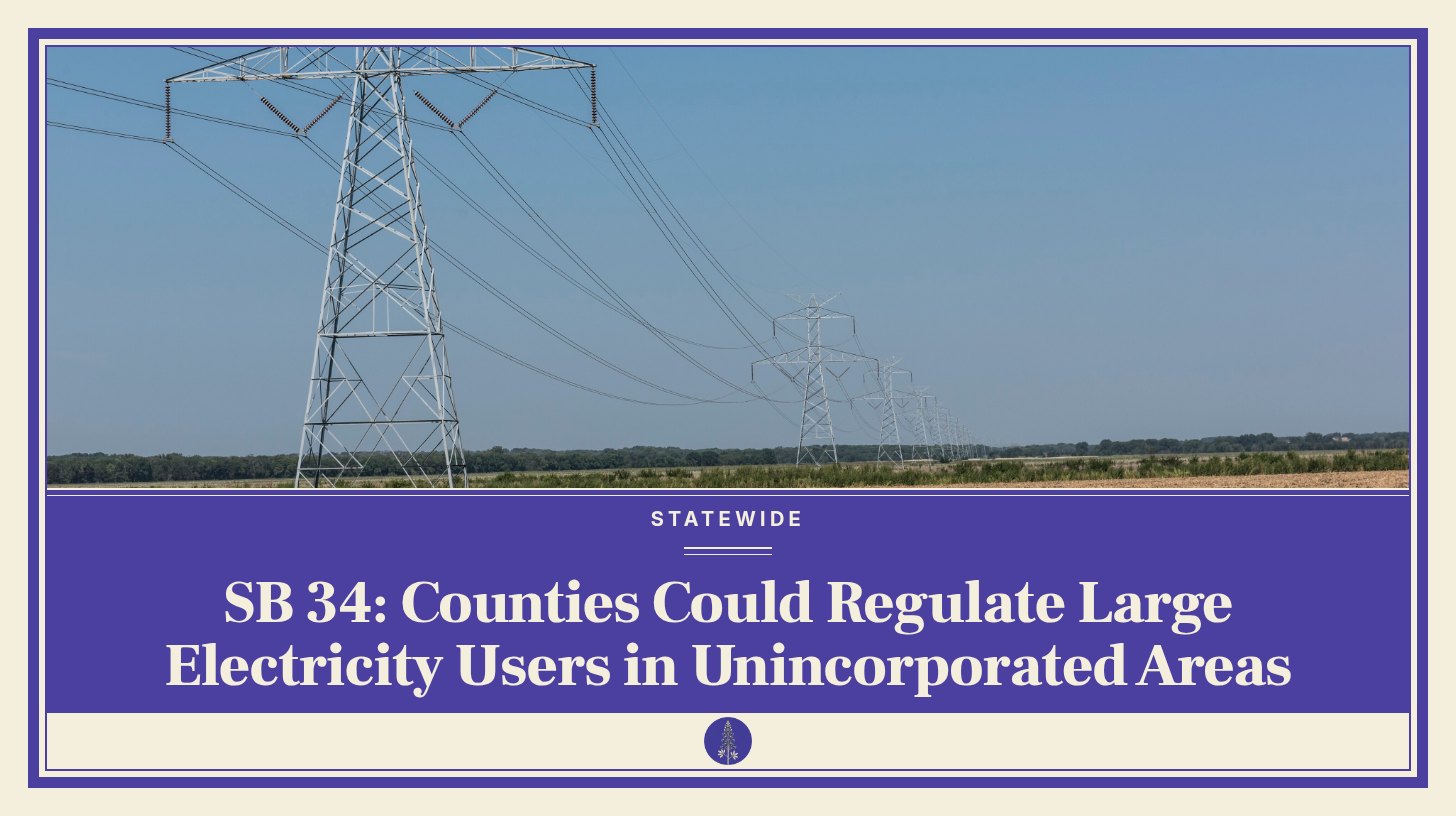
Header photo: Power towers and lines in Ellis County, near Italy, Texas, Sept. 9, 2014. Photo by Carol M. Highsmith, public domain, via the Library of Congress and Wikimedia Commons.
Sources
- SB 34 bill history, 90th Legislature
- SB 34 bill text, as filed
- SB 34 authors
- SB 34 companions
- Sen. Judith Zaffirini, Senate District 21
- Texas Secretary of State election results, Nov. 3, 2026 general election
- Local Government Code Chapter 231, current law
- Local Government Code Sections 232.001 and 232.0025, current law
- Utilities Code Section 37.0561, current law
- Government Code Section 301.001 (session start)