Rep. Brian Harrison (R) HD-10 filed House Bill 731 (Texas Legislature Online) on Nov. 9, 2026. The bill would abolish ad valorem taxes, also called property taxes, beginning Jan. 1, 2033. It would take effect only if voters approve a constitutional amendment proposed by the 90th Legislature to abolish those taxes.
What the Bill Would Change
HB 731 would repeal Title 1 of the Tax Code, which state law says may be cited as the Property Tax Code. Beginning Jan. 1, 2033, the state or a political subdivision of the state could not impose an ad valorem tax. The bill says that ban would control over a conflicting provision in a general or special law. Tax liability that accrued before that date would remain in effect, and the former law would remain in effect for collection and for civil and criminal enforcement of that liability.
The bill would also create a joint interim committee of 10 members on the abolition of ad valorem taxes. The speaker of the house would appoint five members of the house, and the lieutenant governor would appoint five senators, by Feb. 1, 2028. The speaker and the lieutenant governor would each designate a chair from among the committee members. The committee would convene at the joint call of those chairs.
The committee would conduct a comprehensive study to determine how to replace local tax revenue that would be lost when ad valorem taxes are abolished with local sales and use tax revenue. The bill directs the committee to:
- consider whether political subdivisions that currently impose ad valorem taxes would have the authority to impose sales and use taxes
- determine the average sales and use tax rate for each type of political subdivision that would be necessary to generate the same amount of tax revenue as the amount of tax revenue lost as a result of the abolition of ad valorem taxes
- determine, if appropriate, the effect that broadening the application of sales and use taxes at the local level would have on those rates
- identify whether tax revenue generated by sales and use taxes would require redistribution to offset disparities in available local tax revenue as a result of the abolition of ad valorem taxes and, if so, evaluate the different mechanisms of redistribution available
- identify and examine any other issue that would need to be addressed to implement the abolition of ad valorem taxes
On request of the committee, a state agency or political subdivision would have to provide information for the study and assistance in conducting it. The committee would have to submit a written report of its results and any recommendations to the Legislature by Dec. 1, 2028. The committee would be abolished, and that section of the bill would expire, on Jan. 1, 2029.
If voters approve the amendment, the committee provisions and the bill's effective date section would take effect Jan. 1, 2028. The repeal of the Property Tax Code and the ban on imposing ad valorem taxes would take effect Jan. 1, 2033. If the amendment is not approved, the bill says the Act has no effect.
The Related Constitutional Amendment
Texas Legislature Online lists HB 731 as enabling legislation for House Joint Resolution 58. Harrison filed that resolution (Texas Legislature Online) on Nov. 9, 2026. Its caption is, "Proposing a constitutional amendment to abolish ad valorem taxes."
HJR 58 would amend Section 1, Article VIII, of the Texas Constitution by adding subsections (b-1) and (b-2). Under (b-1), a political subdivision of the state could not impose an ad valorem tax on real or personal property in the state for any purpose on or after Jan. 1, 2033. Under (b-2), the state would take full responsibility for the guarantee of the repayment of all bonds issued by a school district before Nov. 2, 2027, and secured by the revenue from the ad valorem taxes imposed by those entities before Jan. 1, 2033. The resolution says the Legislature shall enact laws for the implementation of that subsection.
The current constitution already provides, in Section 1-e of Article VIII, that no state ad valorem taxes shall be levied upon any property within the state. Section 1(b) of the same article now says that all real property and tangible personal property in the state, unless exempt as required or permitted by the constitution, shall be taxed in proportion to its value.
If the Legislature adopts HJR 58, the proposed amendment would be submitted to voters at an election on Nov. 2, 2027. The ballot would be printed to permit voting for or against the proposition: "The constitutional amendment to abolish ad valorem taxes." Article XVII, Section 1, of the Texas Constitution says a proposal to submit an amendment must be approved by a vote of two thirds of all the members elected to each house.
Why It Reaches Rural Texas
The Property Tax Code defines a "taxing unit" as a county, an incorporated city or town, a school district, a special district or authority (including a junior college district, a hospital district, a district created by or pursuant to the Water Code, and other listed districts), or any other political unit of this state that is authorized to impose and is imposing ad valorem taxes on property. Those local governments include counties and school districts that serve rural areas.
The committee's charge includes whether sales and use tax revenue would require redistribution to offset disparities in available local tax revenue after ad valorem taxes were abolished.
Harrison's Texas House member page lists Ellis County as the county he represents.
Where It Stands
HB 731 and HJR 58 have been filed and have not been referred to a committee. Neither has a fiscal note posted yet. The 90th Legislature convenes Jan. 12, 2027. Harrison is the only author listed on both measures.
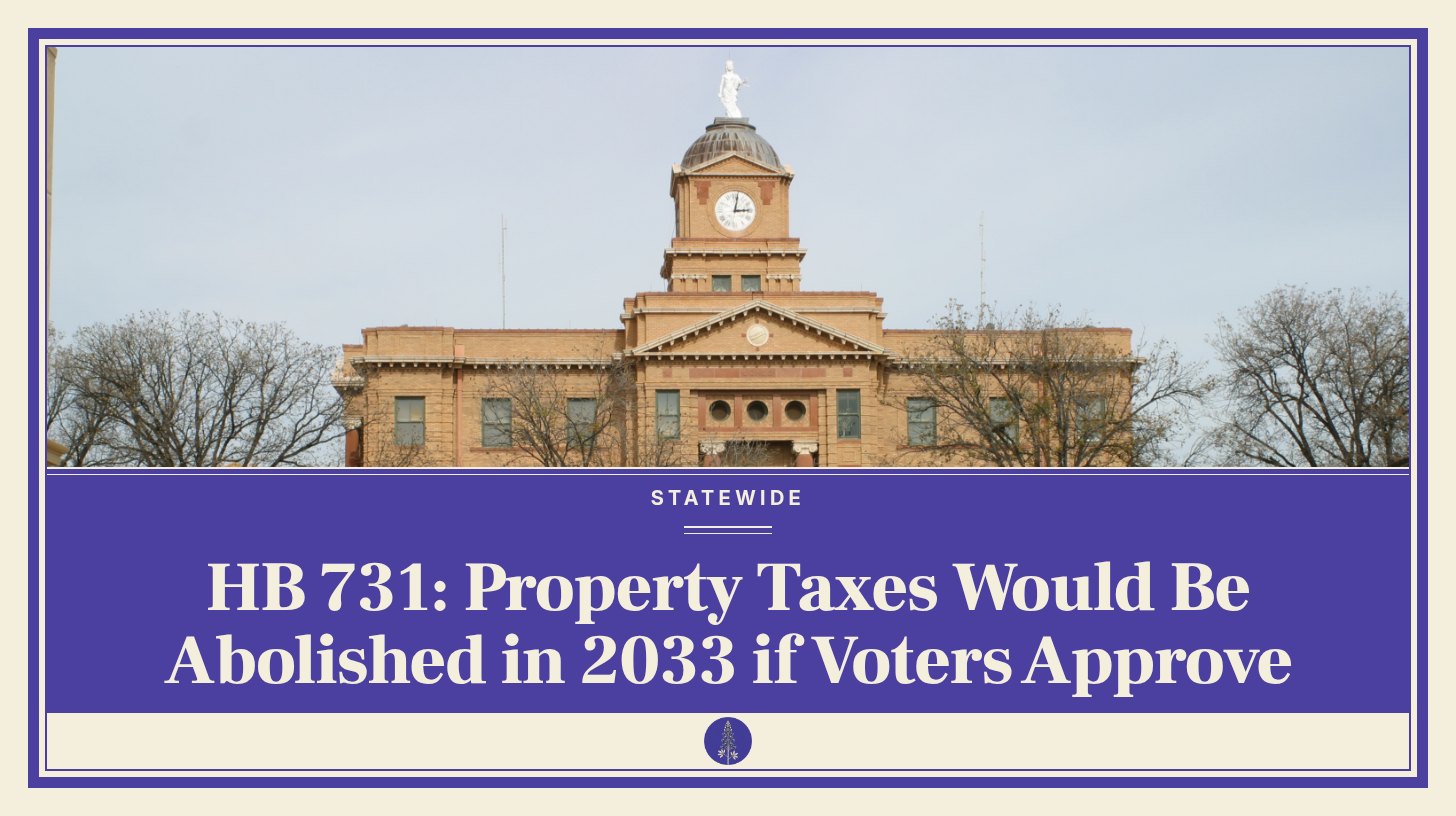
Header photo: The Jones County Courthouse in Anson, the county seat of Jones County in West Texas, Nov. 12, 2009. Photo by Leaflet, public domain, via Wikimedia Commons.
Sources
- HB 731 bill history, 90th Legislature
- HB 731 bill text, as filed
- HB 731 authors
- HJR 58 bill history, 90th Legislature
- HJR 58 text, as filed
- HJR 58 authors
- Rep. Brian Harrison, House District 10
- Legislative Reference Library member profile, Brian Harrison
- Tax Code Title 1, including Sections 1.01 and 1.04
- Texas Constitution, Article VIII, Sections 1 and 1-e
- Texas Constitution, Article XVII, Section 1
- Government Code Section 301.001 (session start)