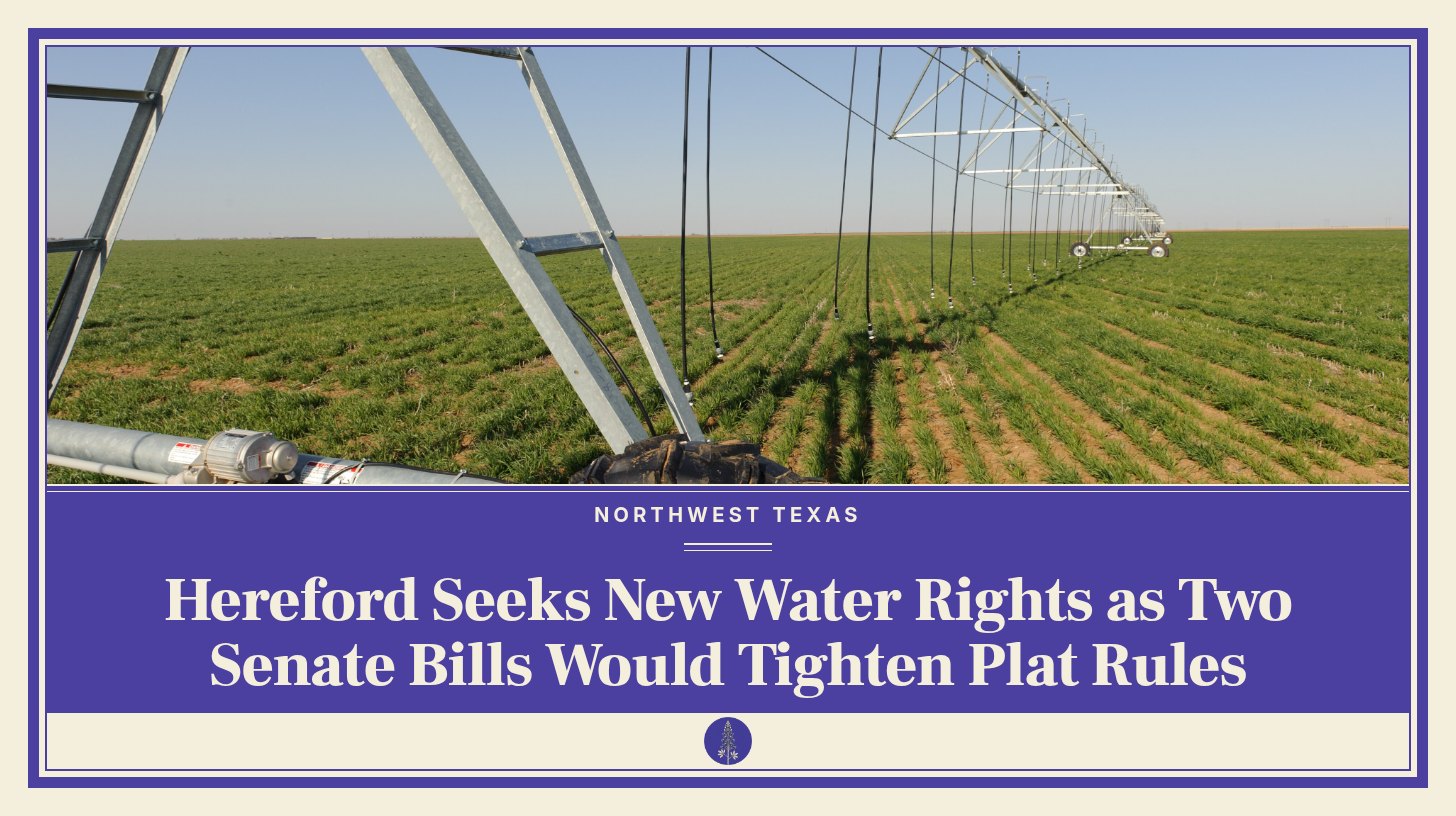
Hereford has enough water to meet its needs for about 11 years under a long-range study the city commissioned from HDR Engineering, and officials are now trying to secure water rights covering about 65,000 acres as the Ogallala Aquifer declines, KVII reported Nov. 10.
“What we’re doing is providing water for generations to come,” City Manager Ryan Polster told the station. “The urgency is great right now. We’re trying to do it as fast as we can because we do have a water plan with a limited amount of water showing on it.” Polster said Hereford would have to buy water rights from irrigators. “This town was built on agriculture,” he said. “We know that there is not a path going forward that doesn’t include the reduction in irrigation, and so I know that we’re going to have to purchase water rights from current irrigators to make this plan work.”
A day earlier, KVII reported that Hedley, in Donley County, was under a boil-water notice for a second week. The town takes its water from the Greenbelt Municipal and Industrial Water Authority. Council member Sylvester Castillo told the station, “We’re asking them to boil their water because we’re waiting on some good samples to come back. It’s definitely for their protection, their own and their animals.” Clarendon Mayor Jacob Fangman said his city, which uses the same source, had not issued a boil-water notice and that recent rain did not raise the reservoir much because the watershed was so dry.
Two Senate bills filed Nov. 9 would change how land is divided and how groundwater supply is certified when a new subdivision is platted. Both would apply statewide. Neither has been referred to a committee. Neither is law. The 90th Legislature convenes Jan. 12, 2027.
Groundwater Certifications on New Plats
Sen. Charles Perry (R) SD-28 filed SB 263 (capitol.texas.gov). Its official caption is “Relating to the regulation of subdivisions and approval of subdivision plans or plats.” Texas Legislature Online lists no joint authors or co-authors.
Under current law, a plat application for a subdivision that would use groundwater under the land must include a statement from a licensed engineer or geoscientist certifying that adequate groundwater is available. The introduced text of SB 263 would require that statement to also comply with rules adopted by the Texas Commission on Environmental Quality, and it would require a city or a commissioners court to disapprove a plat that fails those requirements. TCEQ would have to set the form and content of the certification and define what counts as credible evidence of groundwater availability.
The bill would also narrow two exceptions that now let some rural property owners skip a plat. A county could not use the agricultural-use exception, or the exception for lots larger than 10 acres, if the owner lays out streets, alleys, parks or other parts of the tract intended for use by lot buyers. In a priority groundwater management area, a commissioners court could adopt water availability requirements where platting is required if it finds that current or projected water use would exceed the “safe sustainable yield” of the county’s water supply.
The changes would apply only to plat applications filed on or after the effective date, Jan. 1, 2028. TCEQ would have until that day to adopt the new rules.
When a Plat Is Required Outside a City
Sen. Pete Flores (R) SD-24 filed SB 302 (capitol.texas.gov). Its official caption is “Relating to the subdivision of land outside a municipality for which a plat must be filed.” TLO lists no joint authors or co-authors.
Current law requires a plat when an owner divides a tract outside city limits into two or more parts to lay out a subdivision, lots, or streets and other areas “intended by the owner of the tract to be dedicated to public use.” The introduced text would add areas “intended for private use by a purchaser or owner of a lot.” The bill would take effect Sept. 1, 2027.
The two bills are not listed as companions on TLO, and they have different effective dates. They would change related parts of the same platting law. SB 302 would bring more divisions of rural land under the plat requirement. SB 263 would tighten the groundwater certification that such a plat must carry when the subdivision would pump water from under the land, and it would require cities and counties to reject plats that do not meet those rules.
Sen. Charles Perry (R) SD-28 represents a Lubbock-based Senate district. Sen. Pete Flores (R) SD-24 represents Senate District 24. The bills would apply to unincorporated land statewide, including counties that rely on the Ogallala Aquifer.