Rep. Jeff Barry (R) HD-29 filed House Bill 1176 (capitol.texas.gov) on Nov. 16, 2026. The bill would let a county commissioners court require that a subdivision be included in a special district or authority that has the power to provide for drainage in the subdivision.
Where the Rule Would Apply
The bill amends Section 232.003 of the Local Government Code. That section is part of a subchapter that starts with Section 232.001, which requires the owner of a tract of land outside the limits of a city to have a plat prepared when dividing the tract into two or more parts for a subdivision, lots or streets and parks meant for public use. The plat is filed with the county clerk.
That means the change would apply to land in unincorporated parts of a county, including rural tracts divided into lots.
What Counties Can Require Now
Under current law, a commissioners court may adopt subdivision rules by an order entered in its minutes, after publishing notice in a local newspaper. The section lists nine things the rules can do, including:
set right of way widths for main roads and other roads in a subdivision
set shoulder to shoulder road widths and construction specifications
set drainage specifications for each street or road, following standard engineering practices
set drainage specifications to manage stormwater runoff in the subdivision and fit it to the area’s general storm drainage pattern
require a statement in each purchase contract on whether, how and when water will be available
require the owner to post a bond
require lot and block markers set by a registered professional surveyor before the plat is recorded
A separate section says a county may not hold subdivision roads to a higher standard than it uses for its own roads with similar traffic.
HB 1176 would add a tenth item to that list. The bill does not define a special district or authority with drainage powers, and it does not say how a subdivision would be brought into one or what would happen where no such district exists.
What a District With Drainage Powers Is
State law sets up several kinds of districts that can handle drainage.
Drainage districts under Chapter 56 of the Water Code are created by a commissioners court. The process starts with a petition signed by at least 25 resident freehold taxpayers of the proposed district, or by one third of them if there are fewer than 75. The court holds a hearing and dismisses the petition unless it finds that drainage is feasible, practicable and needed and would serve public health or be a public benefit. A drainage district’s board has to levy a tax on district property high enough to maintain and repair its improvements and pay its debts. For districts operating under Article III, Section 52, of the Texas Constitution, that maintenance tax is capped at one half of one percent of the district’s total assessed value.
Municipal utility districts under Chapter 54 of the Water Code list the control of stormwater and floodwater and the drainage of overflowed land among their purposes. Under that chapter, a district is created on a petition to the Texas Commission on Environmental Quality signed by the holders of a majority in value of the land in the proposed district.
Water Code Section 49.211 lets a district that is authorized to do drainage or flood control work adopt a master drainage plan and construction rules. A district with such a plan may require a developer who is subdividing land inside the district, and who needs county or city plat approval, to submit a drainage report for the district’s approval.
Where It Stands
HB 1176 has been filed and has not been referred to a committee. It has no fiscal note yet. The 90th Legislature convenes Jan. 12, 2027. If the bill passes with a two thirds vote of each chamber, it would take effect right away. Otherwise it would take effect Sept. 1, 2027.
Barry is the only author listed on the bill. His district covers part of Brazoria County.
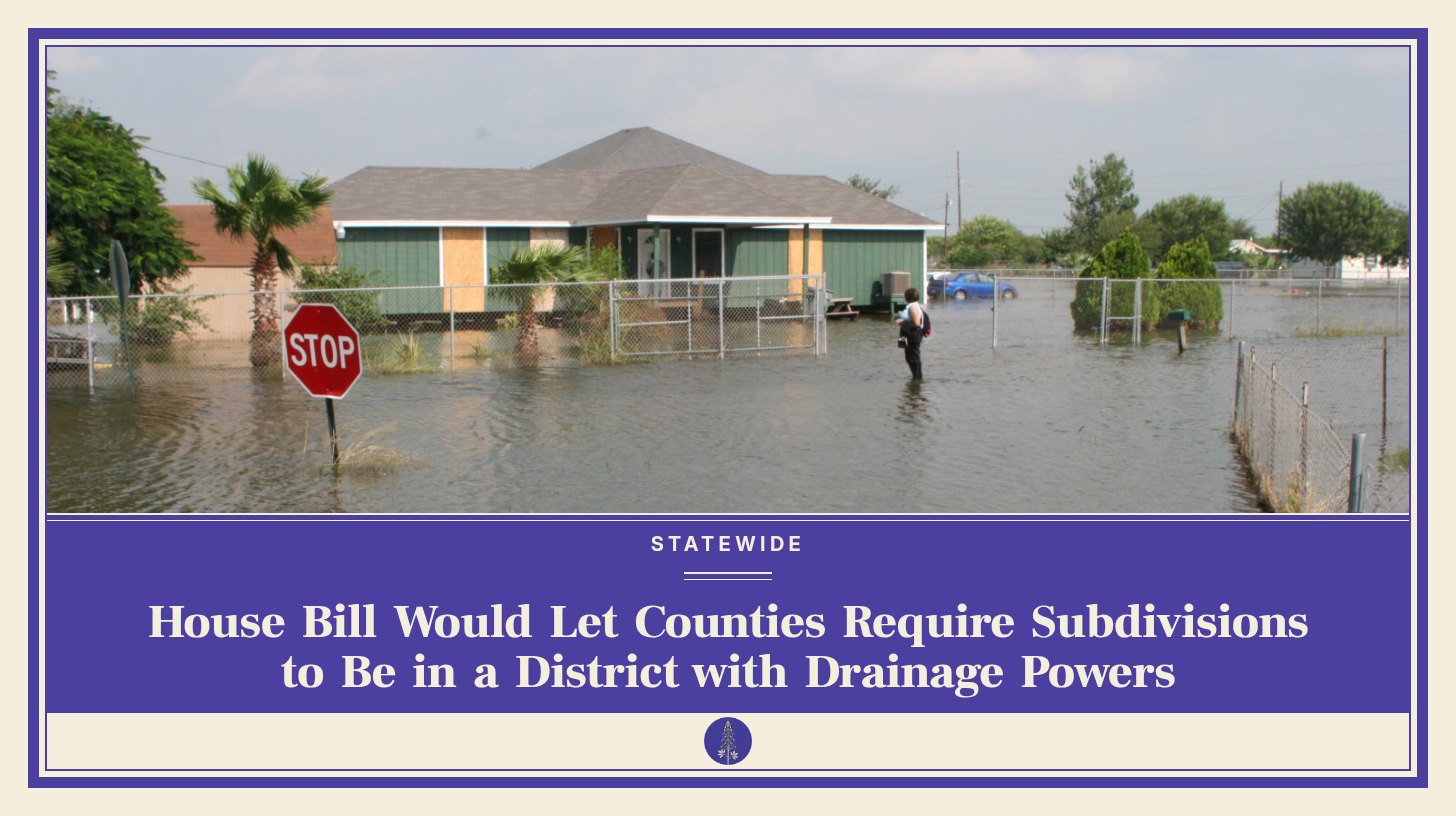
Header photo: A Hidalgo County neighborhood still under water on July 30, 2008, after Hurricane Dolly. FEMA photo by Patricia Brach, public domain, via Wikimedia Commons. The photo’s exact location in the county is not recorded.
Sources
HB 1176 bill history, 90th Legislature: https://capitol.texas.gov/BillLookup/History.aspx?LegSess=90R&Bill=HB1176
HB 1176 bill text, as filed: https://capitol.texas.gov/tlodocs/90R/billtext/html/HB01176I.htm
Rep. Jeff Barry, House District 29: https://house.texas.gov/members/member-page?district=29
Local Government Code Chapter 232 (Sections 232.001, 232.003 and 232.0031): https://statutes.capitol.texas.gov/Docs/LG/htm/LG.232.htm
Water Code Chapter 56 (drainage districts): https://statutes.capitol.texas.gov/Docs/WA/htm/WA.56.htm
Water Code Chapter 54 (municipal utility districts): https://statutes.capitol.texas.gov/Docs/WA/htm/WA.54.htm
Water Code Chapter 49, Section 49.211 (district drainage powers): https://statutes.capitol.texas.gov/Docs/WA/htm/WA.49.htm
Government Code Section 301.001 (session start): https://statutes.capitol.texas.gov/Docs/GV/htm/GV.301.htm
This story was first published on our Substack.