Rep. Philip Cortez (D) HD-117 filed House Bill 1175 (capitol.texas.gov) on Nov. 16, 2026. The bill would have the Texas Parks and Wildlife Department waive the state park entrance fee for some Texas residents who serve as first responders. It would also have the Texas Parks and Wildlife Commission waive their fees for a resident hunting license, a resident fishing license and an annual combination resident hunting and fishing license.
Who Would Qualify
A first responder would have to be a Texas resident who has completed at least 20 years of continuous service as a first responder, or who has a disability connected to that service. The disability would have to be the loss of the use of a lower extremity or a disability rating of 50 percent or more. The bill does not say who would assign the rating, and it does not define continuous service.
The bill defines a first responder as:
a firefighter certified by the Texas Commission on Fire Protection or by the State Firefighters’ and Fire Marshals’ Association of Texas
a person certified as emergency medical services personnel by the Department of State Health Services
a municipal police officer
a sheriff, deputy sheriff or reserve deputy sheriff
a constable, deputy constable or reserve deputy constable
The list does not name state troopers, game wardens or school district police officers.
For the park waiver, the bill counts as a resident anyone who has lived in Texas continuously for more than six months before the park visit. It also counts the groups that state hunting law already treats as residents, including active duty members of the U.S. armed forces and their dependents.
Volunteer Firefighters
A volunteer firefighter would count as a first responder under the bill only if certified by one of the two bodies named in it. State law has the Texas Commission on Fire Protection run a voluntary certification program for volunteer firefighters and volunteer fire departments, and it says volunteers are not required to take part. The State Firefighters’ and Fire Marshals’ Association of Texas runs its own certification program. The association says on its website that its certifications cover National Fire Protection Association objectives “in a format easily managed on a part-time basis by the volunteer fire service.”
Texas A&M Forest Service, which runs the state’s grant program for rural volunteer fire departments, said in June 2026 that more than 85 percent of Texas fire departments are volunteer.
What the Fees Cost Now
The department’s current price list shows a resident hunting license at $25. Its Super Combo package, which includes resident hunting and fishing licenses plus five endorsements, is $68. The bill waives license fees and does not mention endorsements.
Park entrance fees are set park by park. Fort Parker State Park, for example, lists $5 a day for each adult. A Texas State Parks Pass, which covers entry at 88 state parks for a year, costs $70. The bill covers the entrance fee and does not mention camping or other facility fees.
State law already requires the commission to waive resident hunting and fishing license fees for veterans with a qualifying service connected disability and for residents on active duty in the U.S. military, the Texas Army or Air National Guard or the Texas State Guard. HB 1175 would use the same disability standard for first responders: loss of the use of a lower extremity or a rating of 50 percent or more.
An Earlier Version
Cortez filed a bill with the same caption for the 2025 session, House Bill 696 (capitol.texas.gov), on Nov. 12, 2024. Rep. Richard Peña Raymond (D) HD-42 signed on as joint author. Texas Legislature Online shows it was referred to the House Committee on Culture, Recreation and Tourism on March 4, 2025, with no later action. Its text matches HB 1175 except for the effective date. No fiscal note was posted for it.
Where It Stands
HB 1175 has been filed and has not been referred to a committee. It has no fiscal note yet. The 90th Legislature convenes Jan. 12, 2027. If the bill passes, it would take effect Sept. 1, 2027. The license changes would apply only to licenses issued on or after that date, and the department would not have to refund licenses issued before it.
Cortez is the only author listed on the bill. His district covers part of Bexar County.
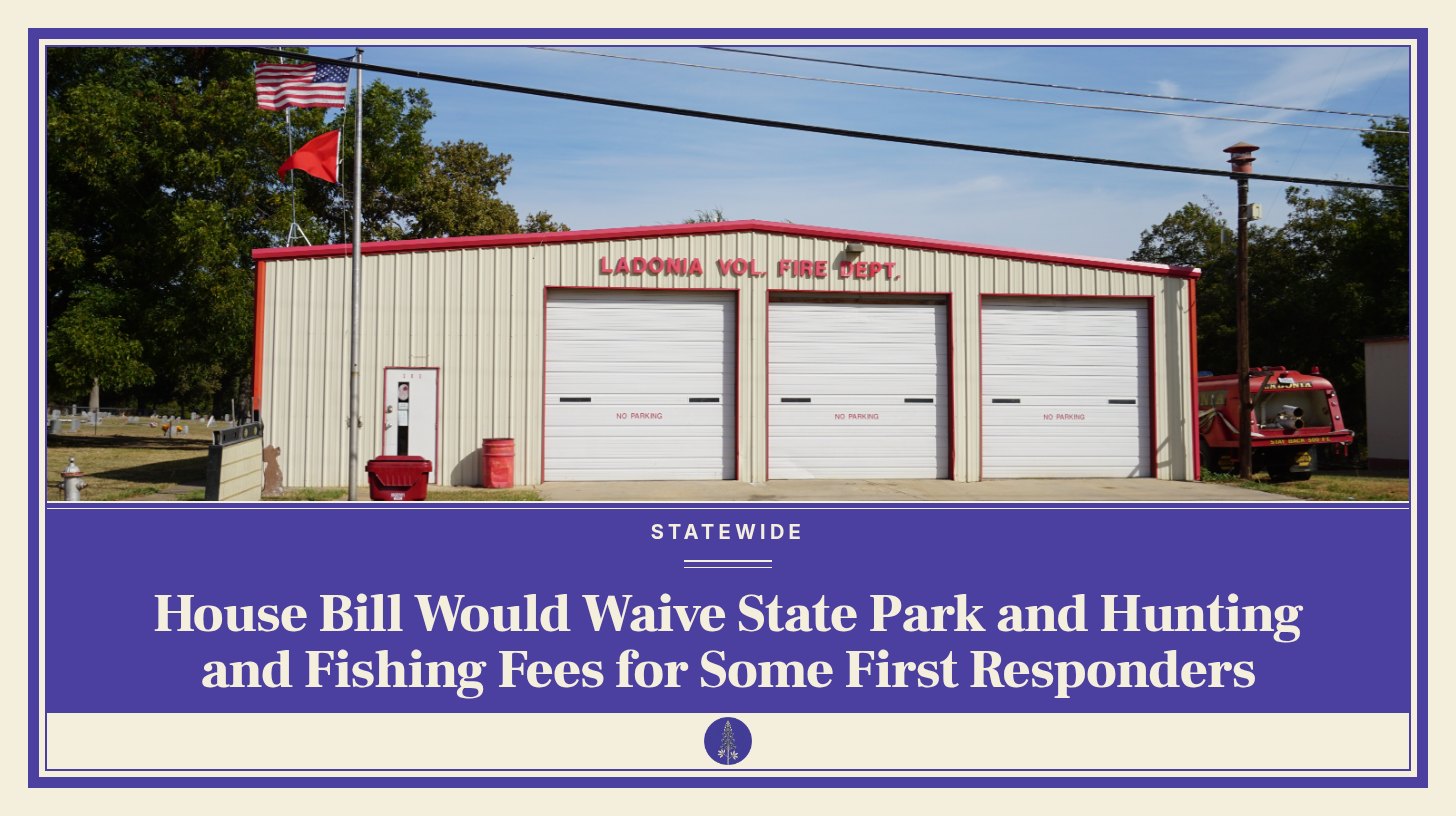
Header photo: The Ladonia Volunteer Fire Department station in Ladonia, Fannin County, Oct. 17, 2015. Photo by Michael Barera, CC BY-SA 4.0, via Wikimedia Commons.
Sources
HB 1175 bill history, 90th Legislature: https://capitol.texas.gov/BillLookup/History.aspx?LegSess=90R&Bill=HB1175
HB 1175 bill text, as filed: https://capitol.texas.gov/tlodocs/90R/billtext/html/HB01175I.htm
HB 696 bill history, 89th Legislature: https://capitol.texas.gov/BillLookup/History.aspx?LegSess=89R&Bill=HB696
HB 696 bill text, as filed: https://capitol.texas.gov/tlodocs/89R/billtext/html/HB00696I.htm
Rep. Philip Cortez, House District 117: https://house.texas.gov/members/member-page?district=117
Rep. Richard Peña Raymond, House District 42: https://house.texas.gov/members/member-page?district=42
Parks and Wildlife Code Chapter 42 (resident definition, hunting license fee waivers): https://statutes.capitol.texas.gov/Docs/PW/htm/PW.42.htm
Parks and Wildlife Code Chapter 46 (fishing license fee waivers): https://statutes.capitol.texas.gov/Docs/PW/htm/PW.46.htm
Government Code Chapter 419, Section 419.071 (volunteer firefighter certification): https://statutes.capitol.texas.gov/Docs/GV/htm/GV.419.htm
State Firefighters’ and Fire Marshals’ Association of Texas, certification program: https://www.sffmatx.org/why-participate
Texas A&M Forest Service, June 5, 2026 grant release: https://tfsweb.tamu.edu/texas-am-forest-service-awards-29-million-to-texas-fire-departments/
Texas Parks and Wildlife, hunting licenses: https://tpwd.texas.gov/regulations/outdoor-annual/licenses/hunting-licenses-and-permits/hunting-licenses
Texas Parks and Wildlife, Super Combo and combo packages: https://tpwd.texas.gov/regulations/outdoor-annual/licenses/combination-hunting-fishing/super-combo-combo-license-packages
Texas Parks and Wildlife, park passes: https://tpwd.texas.gov/state-parks/park-information/passes
Fort Parker State Park entrance fees: https://tpwd.texas.gov/state-parks/fort-parker/fees-facilities/entrance-fees
Government Code Section 301.001 (session start): https://statutes.capitol.texas.gov/Docs/GV/htm/GV.301.htm
This story was first published on our Substack.