The Texas Animal Health Commission signed two modified New World screwworm orders on Nov. 16, 2026. One followed a detection that day in a bovine in Starr County and redrew that area’s zone so it now takes in part of Hidalgo County. The other followed a Nov. 15 detection in a bovine in Brewster County.
The New Orders
Infested Zone 29.C covers parts of Hidalgo, Jim Hogg, Starr and Zapata counties. It replaces the commission’s Nov. 4 order for the area. According to the new order, the zone was first set up Nov. 2 as Infested Zone 29 after a detection in a bovine in Zapata County, and later detections in Starr County led to modified orders on Nov. 3 and Nov. 4.
Infested Zone 13.D covers parts of Brewster and Pecos counties. It replaces an Oct. 3 order. The order says the zone was first set up July 9, 2026, after a detection in a bovine in Brewster County, and was modified July 14, Sept. 28 and Oct. 3.
Both orders took effect immediately. Each says it stays in effect until the commission releases the quarantine.
Where the Restrictions Apply
The commission’s public notice now lists movement restrictions in parts of 32 Texas counties. Hidalgo County was not on the list of 31 counties the notice showed when The Bluebonnet Express checked it early Nov. 16. Each zone is drawn on a map in its order, so the rules apply only inside those zone lines and not to every acre of a listed county. Grouped by The Bluebonnet Express regions, the counties are:
West Texas: Brewster, Culberson, El Paso, Fisher, Hudspeth, Irion, Jeff Davis, Mitchell, Nolan, Pecos, Presidio, Reagan, Reeves, Scurry and Terrell
Hill Country: Bandera, Crockett, Edwards, Schleicher, Sutton and Val Verde
South Texas: Brooks, Goliad, Jim Hogg and Zapata
Southwest Texas: Dimmit, Frio, La Salle, Medina and Zavala
Rio Grande Valley: Hidalgo and Starr
What the Orders Require
Under both orders, warm-blooded animals in the zone may not be moved out without prior authorization from the commission. To leave, an animal has to be inspected and treated as the commission requires and be issued a permit or certificate for movement by a commission representative. Hides, carcasses and parts of any animal that could host the pest have to be inspected, and treated if a commission representative deems it necessary, before they leave the zone. The orders say unauthorized movement is prohibited and subject to administrative penalties or criminal prosecution.
The commission’s page says inspections for moving animals out of a zone can be scheduled with its deployed inspectors at 512-714-1936, or with a certified inspector from the list on its website.
The Case Count
The commission’s page now reports 79 Texas premises with at least one confirmed detection during the 2026 outbreak. It reported 77 on the morning of Nov. 16. The count of Texas counties with a confirmed detection is unchanged at 25. The first Texas case was confirmed June 3, 2026, in a calf in Zavala County.
How to Report a Case
The commission asks that suspected cases in livestock and pets be reported to a commission region office or to the veterinarian on call at 1-800-550-8242. Suspected cases in wildlife go to the Texas Parks and Wildlife Department at 512-389-4505.
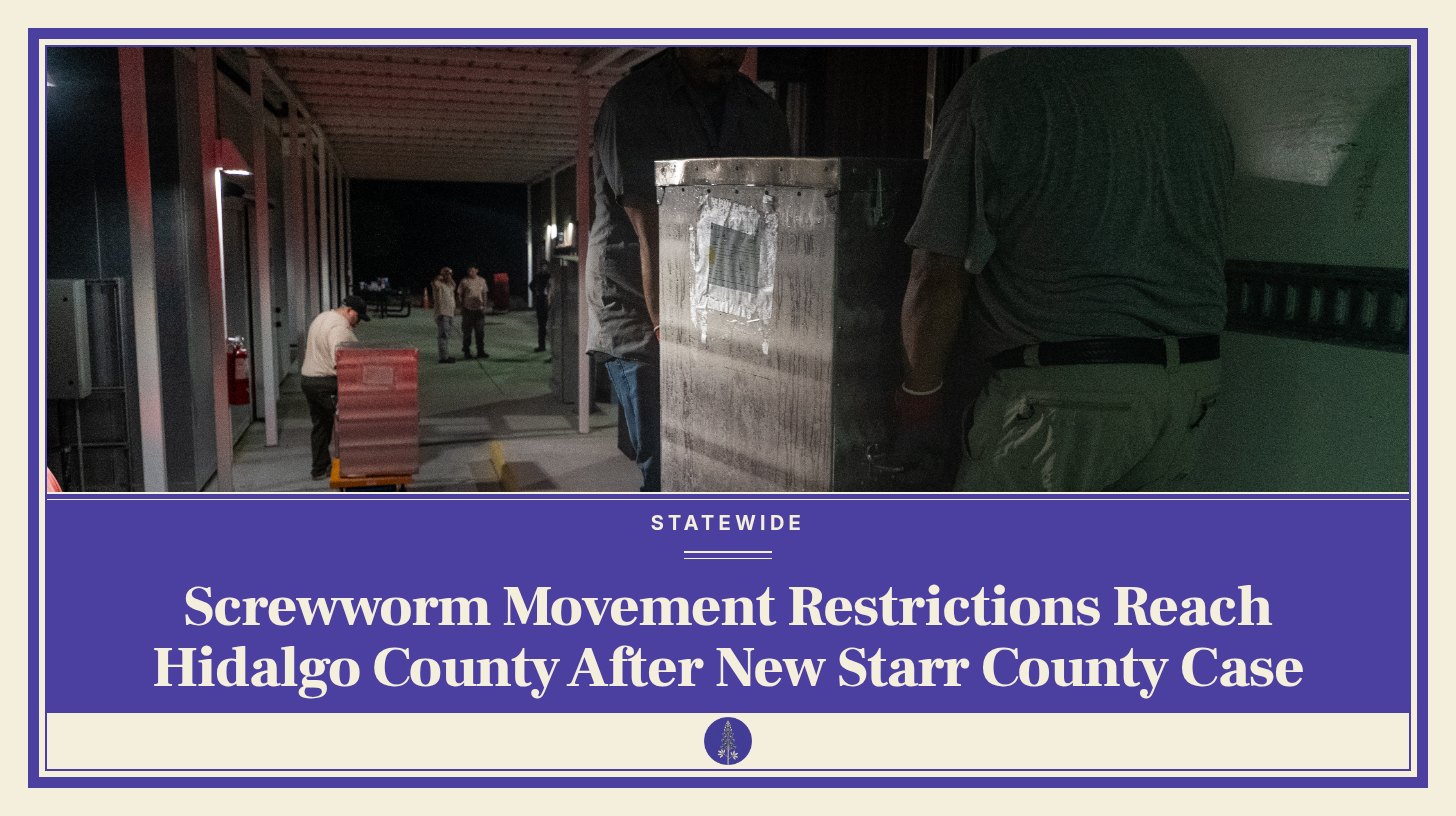
Header photo: Workers load containers packed with sterile New World screwworm flies for an aerial release over Texas along the border on July 2, 2026. U.S. Department of Agriculture photo, public domain, via Wikimedia Commons.