Rep. Tom Craddick (R) HD-82 filed House Bill 1269 (Texas Legislature Online) on Nov. 20, 2026. The bill would amend Transportation Code Sections 644.101 and 644.103 so that constables and deputy constables, in addition to municipal police officers, sheriffs, and deputy sheriffs, could be certified to enforce commercial motor vehicle safety standards, and so that a certified constable or deputy constable in a county listed in Section 644.101(c) could stop, enter, or detain a motor vehicle subject to Chapter 644 on a highway or at a port of entry within the territory of the county. HB 1269 has been filed and has not become law.
What the Bill Would Change
SECTION 1 would amend Transportation Code Section 644.101(a) and (c). Under Subsection (a) as amended, the department shall establish procedures, including training, for the certification of municipal police officers, sheriffs, deputy sheriffs, constables, and deputy constables to enforce Chapter 644. The words "constables, and deputy constables" are new language added by the bill.
Under Subsection (c) as amended, a sheriff, deputy sheriff, constable, or deputy constable of any of the following counties is eligible to apply for certification under the section. The words "constable, or deputy constable" are new language added by the bill. The introduced text restates, without added or deleted language in the county list itself, these categories:
(1) a county bordering the United Mexican States;
(2) a county with a population of less than 1,000, part of which is located within 75 miles of an international border;
(3) a county with a population of 700,000 or more;
(4) a county with a population of 400,000 or more that borders the county in which the State Capitol is located;
(5) a county with a population of less than 250,000 that is adjacent to two counties that each have a population of more than 1.2 million, and that contains two highways that are part of the national system of interstate and defense highways;
(6) a county any part of which is within 30 miles of New Mexico, and that is adjacent to two or more counties that generated $100 million or more in tax revenue collected under Chapters 201 and 202, Tax Code, from oil and gas production during the preceding state fiscal year;
(7) a county with a population of more than 40,000 and less than 300,000 that is adjacent to a county described by Subdivision (4); or
(8) a county with a population of more than 50,000 and less than 90,000 that is adjacent to a county with a population of more than 4,000,000.
SECTION 2 would amend Transportation Code Section 644.103(b). A municipal police officer who is certified under Section 644.101 may stop, enter, or detain on a highway or at a port of entry within the territory of the municipality a motor vehicle that is subject to Chapter 644. Under the subsection as amended, a sheriff, deputy sheriff, constable, or deputy constable who is certified under Section 644.101 may stop, enter, or detain on a highway or at a port of entry within the territory of the county a motor vehicle that is subject to the chapter. The words "constable, or deputy constable" in that sentence are new language added by the bill.
When It Would Apply
SECTION 3 says the Act takes effect immediately if it receives a vote of two-thirds of all the members elected to each house, as provided by Section 39, Article III, Texas Constitution. If it does not receive that vote, it takes effect Sept. 1, 2027.
Why It Reaches Rural Texas
Certification and enforcement authority for sheriffs, deputy sheriffs, constables, and deputy constables would apply only in the counties described by Section 644.101(c). That list includes counties defined by an international border, by a population of less than 1,000 near a border, and by proximity to New Mexico together with adjoining oil and gas production tax collections, as well as counties defined by larger population brackets and highway or adjacency tests. A certified constable or deputy constable could stop, enter, or detain a subject motor vehicle on a highway or at a port of entry within the territory of the county. The bill does not name individual counties, and it does not add or remove county categories from Section 644.101(c).
Where It Stands
HB 1269 has been filed and has not been referred to a committee. No fiscal note is posted yet, and the companions page says the bill does not have any companions. Craddick is the only author listed. The 90th Legislature convenes Jan. 12, 2027.
The official House member page lists Rep. Craddick, Tom, District 82, and names Dawson, Martin, and Midland as the counties represented.
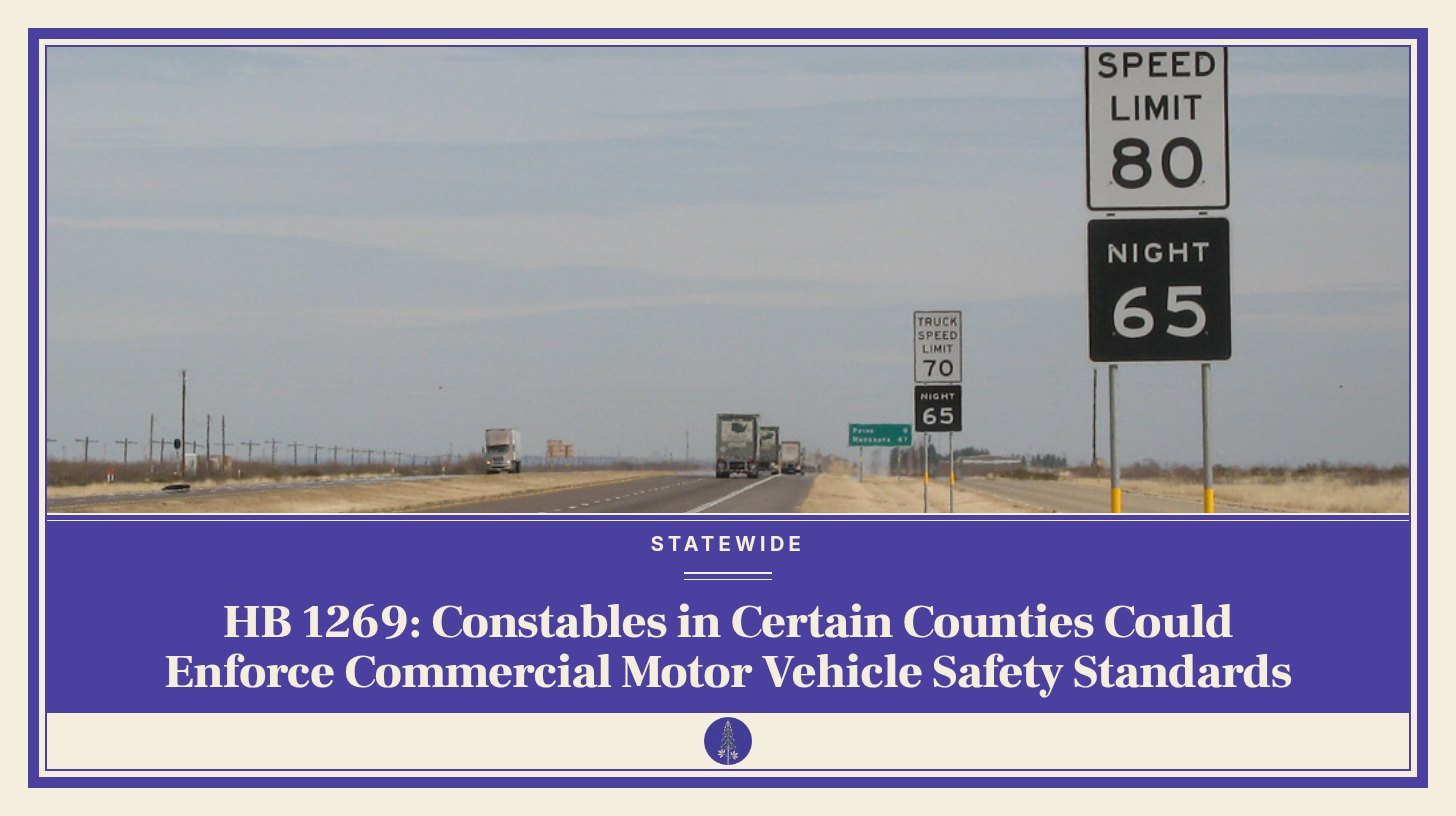
Header photo: Interstate 20 eastbound, 7 miles west of Pecos, Texas, Jan. 11, 2007, with commercial trucks and a truck speed limit sign. Photo from houstonfreeways.com, public domain, via Wikimedia Commons.