Rep. Brent Money (R) HD-2 filed House Joint Resolution 23 (Texas Legislature Online) and House Bill 144 (Texas Legislature Online) on Nov. 9, 2026. HJR 23 proposes a constitutional amendment to abolish ad valorem taxes, also called property taxes. The resolution would submit the proposed amendment to the voters at an election on Nov. 2, 2027. If voters approve it, a political subdivision of the state could not impose an ad valorem tax for any purpose on or after Jan. 1, 2032, except as needed to repay the principal of and interest on certain bonds and other obligations issued before that date. HB 144 would create a nine-member commission to study alternative methods of taxation to replace revenue lost to political subdivisions if ad valorem taxes are abolished. Both measures have been filed and have not become law.
What HJR 23 Would Change
HJR 23 would amend Section 1, Article VIII, of the Texas Constitution by adding subsections (k) and (l).
Under proposed subsection (k), except as provided by subsection (l), a political subdivision of this state may not impose an ad valorem tax for any purpose on or after Jan. 1, 2032.
Under proposed subsection (l), on or after Jan. 1, 2032, a political subdivision of this state shall impose an ad valorem tax on taxable property in the political subdivision in accordance with the law as it existed immediately before that date, as necessary to repay the principal of and interest on bonds or other obligations issued by the political subdivision before that date that are secured wholly or partly by the revenue from the ad valorem taxes imposed by the political subdivision, until the obligations are paid in full. The revenue from ad valorem taxes imposed under this subsection may be used only for that purpose.
The ballot would be printed to permit voting for or against the proposition: 'The constitutional amendment to abolish ad valorem taxes.'
What HB 144 Would Do
HB 144 would create the Commission to Study Measures to Abolish Ad Valorem Taxes. The commission would have nine members: the comptroller of public accounts; three members of the senate appointed by the lieutenant governor; three members of the house of representatives appointed by the speaker of the house of representatives; and two public members appointed by the governor. The comptroller would be the presiding officer. The commission would meet at the call of the presiding officer. The staff of the office of the comptroller of public accounts would serve as the staff of the commission. A commission member would not be entitled to compensation for service on the commission but would be entitled to reimbursement for actual and necessary expenses, including travel expenses, incurred in performing commission duties.
The commission would conduct a study of alternative methods of taxation to replace revenue lost to political subdivisions if ad valorem taxes are abolished. Not later than Dec. 1, 2028, the commission would issue a report of the results of the study, including any legislative recommendations, to the governor, the lieutenant governor, the speaker of the house of representatives, and the presiding officer of each legislative standing committee with jurisdiction over taxation. The commission would be abolished, and the Act would expire, on Sept. 1, 2029.
The Act would take effect immediately if it receives a vote of two-thirds of all the members elected to each house, as provided by Section 39, Article III, of the Texas Constitution. If it does not receive that vote, it would take effect Sept. 1, 2027. The introduced text does not condition the study, the report, or the effective date on voter approval of HJR 23. Texas Legislature Online does not list the two measures as companions.
Why It Reaches Rural Texas
The proposed constitutional ban would apply to political subdivisions of the state, including counties, cities, and school districts that impose ad valorem taxes, and it is not limited by population or to Money's district. The subjects listed on the HJR 23 history page include school finance and city, county, and school district taxation. The study in HB 144 would address alternative methods of taxation to replace revenue lost to political subdivisions if those taxes are abolished.
The official House member page lists Rep. Money, Brent, District 2, and names Hopkins, Hunt, and Van Zandt as the counties represented.
Where It Stands
HJR 23 and HB 144 have been filed and have not been referred to a committee. No fiscal note is posted yet for either measure. Money is the only author listed on both. The 90th Legislature convenes Jan. 12, 2027.
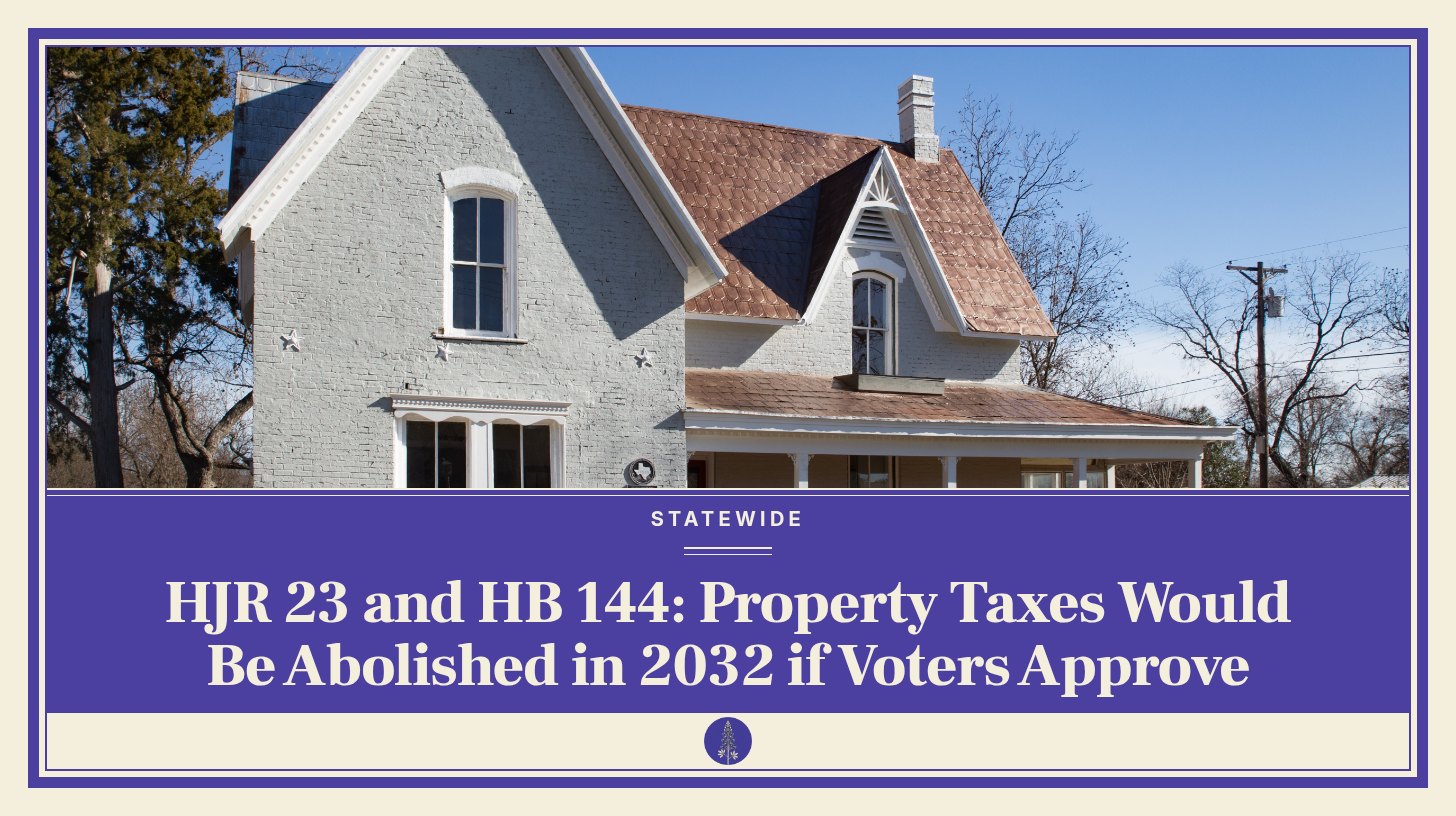
Header photo: The General Hal C. Horton Home, a historic house in Greenville, Texas, Dec. 25, 2019. Photo by Renelibrary, CC BY-SA 4.0, via Wikimedia Commons.
Sources
- HJR 23 bill history, 90th Legislature
- HJR 23 text, as filed
- HJR 23 authors
- HJR 23 companions
- HB 144 bill history, 90th Legislature
- HB 144 bill text, as filed
- HB 144 authors
- HB 144 companions
- Rep. Brent Money, House District 2
- Legislative Directory member page, Representative Brent A. Money
- Texas Secretary of State election results, Nov. 3, 2026 general election
- Sessions and years, Texas Legislative Reference Library