Rep.-elect Cecilia Castellano (D) HD-80 filed House Bill 1273 (Texas Legislature Online) on Nov. 20, 2026. The bill would add Chapter 398 to the Health and Safety Code on the siting, construction, permitting, and operation of certain data centers. It would impose a temporary moratorium, require local option elections, create a Texas Commission on Environmental Quality data center impact permit, require annual stipend payments to eligible residents of a host county, repeal certain Tax Code exemptions, and provide civil penalties. HB 1273 has been filed and has not become law.
What the Bill Would Change
SECTION 1 would add Chapter 398, titled "Data Center Siting, Community Consent, and Public Benefit." In Section 398.001, a "covered data center" means one or more buildings, facilities, or installations under common ownership or control, or designed or operated as an integrated project, that contain or are proposed to contain computing equipment used for processing, storage, distribution of data, or artificial intelligence, and that have a designed aggregate maximum electric demand of 20 megawatts or more, or that contain or are proposed to contain 50,000 square feet or more of space primarily devoted to that equipment. A "project" includes a new covered data center or an expansion that increases a center's maximum electric demand by 10 megawatts or more or gross equipment floor area by 25,000 square feet or more. A "host county" is the county in which a covered data center is located; if the center occupies land in more than one county, each is a host county and payments under Subchapter E must be allocated in proportion to the maximum electric demand of the equipment in each county. An "eligible resident" is a natural person whose principal residence is in a host county for at least 183 days of the calendar year for which a stipend is paid, including a minor child, with payment to a minor made to the child's parent or legal guardian. Ownership of real property, citizenship status, and income may not be used as conditions of eligibility.
Section 398.002 would treat adjacent or nearby facilities within two miles that share a common developer, financing, utility interconnection, water supply, or operational plan as presumed to be one covered data center. A person may not divide, phase, lease, convey, or separately permit a project for the purpose of avoiding the chapter. Section 398.003 says the chapter applies to projects proposed after the effective date of the Act adding the chapter and to covered projects that have not commenced substantial physical construction on that date. It does not dispense with any permit, approval, or requirement imposed by federal or state law, a groundwater conservation district, or a political subdivision. A permit, interconnection agreement, zoning approval, or incentive agreement would not substitute for approval required by the chapter.
Subchapter B would impose a two-year moratorium. Before the second anniversary of the effective date, a state agency or political subdivision may not issue a permit, approval, authorization, or certificate for the construction or expansion of a project, and a utility may not energize a new or expanded electric service connection for a project. A person may not commence or continue substantial physical construction of a project during that period, except work necessary to address an imminent threat to life, health, or the environment or to maintain a facility in lawful operation on the effective date. An application submitted during the moratorium may be received and reviewed, but no approval may be issued and no vested right to approval would arise from its submission or review. The moratorium would not prohibit continued operation at the lawfully authorized demand and floor area of a covered data center in commercial operation on the effective date. An expansion would remain subject to the moratorium.
Subchapter C would require local option elections. TCEQ may not issue a permit under the chapter unless the development of the project has been approved by a majority of voters voting at a local option election. For a project in an unincorporated area, the county shall conduct the election among the registered voters of the county. For a project within a municipality, the municipality shall conduct an election among its registered voters and the county shall conduct a separate election among its registered voters; both elections must approve the project. If the project crosses municipal or county boundaries, each affected municipality and county must approve the project by separate election. The developer shall reimburse each political subdivision for the reasonable cost of the election. The ballot would identify the project, its general location, proposed maximum electric demand in megawatts, and projected annual water use in gallons. A project rejected at an election may not be submitted for another election before the second anniversary of that election. An approval would not authorize a material increase of more than 10 percent in the demand, water use, or physical footprint disclosed to voters; a material increase would require another election. At least 60 days before the election, the developer shall provide a plain-language impact statement on a publicly accessible website and by first-class mail to residents of the host county.
Subchapter D would require a data center impact permit issued by TCEQ, in addition to all other approvals required by law, before a person may construct, expand, or commence operation of a project. An application must contain independently verified studies of projected electric demand and effects on residential rates and grid reliability; daily and annual water withdrawals and consumptive use, drought-stage operation, aquifer and surface-water impacts, and effects on drinking-water availability; air emissions; noise; cumulative impacts; and site restoration, emergency response, financial assurance, and mitigation. Before issuing a permit, TCEQ shall obtain written findings from the Public Utility Commission of Texas concerning electric reliability, system costs, and compliance with Utilities Code Section 37.0561, and from the Texas Water Development Board concerning water supply and drought impacts. TCEQ may issue a permit only if the applicant establishes by a preponderance of the evidence a list of findings set out in Section 398.152(b), including that the project will not materially impair the ability of local residents to obtain affordable, reliable electricity or drinking water; that the developer will bear reasonably attributable incremental interconnection and utility infrastructure costs without shifting those costs to residential ratepayers; that the project incorporates water-efficient cooling technology and an enforceable drought curtailment plan; and that the applicant has obtained local approval and entered into all agreements required by Subchapter E.
On the request of an affected person, TCEQ shall refer the application to the State Office of Administrative Hearings for a contested case hearing. A resident, property owner, or political subdivision within the host county is an affected person for that purpose. A permit holder shall meter electric consumption and water withdrawals and consumption separately for each project and submit quarterly verified reports. TCEQ shall review a permit at least once every five years. Before construction, the developer shall provide a bond or other financial assurance in an amount determined by TCEQ sufficient to fund site reclamation, groundwater remediation if applicable, and the correction of reasonably foreseeable off-site harms.
Subchapter E would require the developer, as a condition of receiving and maintaining a permit, to establish an independently audited county resident stipend fund for each host county, held in trust solely for payments to eligible residents of that county. The fund may not be used for general county operations, economic development subsidies, tax abatements, or payments to the developer or an affiliate. For each calendar year during which a covered data center operates, the developer and operator are jointly and severally liable for an annual county resident stipend payment equal to the greater of two percent of gross receipts derived from specified computing and related services performed using the covered data center, or $10,000 multiplied by the number of megawatts of the covered data center's maximum authorized electric demand. The payment is due March 1 for the preceding calendar year. Not later than June 1 of each year, the administrator of the fund shall distribute the money received, less reasonable audited administrative expenses not exceeding two percent of the annual payment, in equal per-person amounts to all eligible residents of the host county. A stipend may not depend on ownership of a homestead or other property, income, employment, or whether the recipient lives within a specified distance of the data center. The payment would be in addition to all taxes and other obligations and may not be collected through a separately identified charge on residential electricity or water bills.
Subchapter F would make a person who constructs, expands, or operates a project in violation of the chapter liable to the state for a civil penalty not to exceed $25,000 for each day of violation, with each day a separate violation. The attorney general, on request of TCEQ or an affected political subdivision, may bring an action for an injunction and civil penalties.
SECTIONS 2, 3, and 4 would amend Tax Code Sections 151.317, 321.208, and 323.207 to remove references to Sections 151.359 and 151.3595. SECTION 5 would repeal Tax Code Sections 151.359, 151.3595, and 313.009. SECTION 6 says an exemption under Section 151.359 or 151.3595 to which a person is entitled on the effective date of the Act expires on that date, and that no person is entitled to a refund or credit based on property purchased on or after that date under either repealed section. An application for certification as a qualifying data center or qualifying large data center project pending on the effective date would be considered denied and may not be approved by the comptroller.
When It Would Apply
SECTION 7 would require TCEQ, the Public Utility Commission of Texas, and the Texas Water Development Board to adopt initial rules under Chapter 398 not later than March 1, 2028. The moratorium imposed by Section 398.051 would terminate on the second anniversary of the effective date of the Act, but all other provisions of Chapter 398 would remain effective after that date. The requirements of Subchapter E would apply only to projects for which a permit is first issued under the chapter after the effective date. SECTION 9 says the Act takes effect immediately if it receives a vote of two-thirds of all the members elected to each house, as provided by Section 39, Article III, Texas Constitution. If it does not receive that vote, it takes effect Sept. 1, 2027.
Why It Reaches Rural Texas
For a project in an unincorporated area, the local election would be conducted among the registered voters of the county. The permit application would have to include independently verified studies of water withdrawals, aquifer and surface-water impacts, and effects on drinking-water availability, and TCEQ would have to obtain written findings from the Texas Water Development Board on water supply and drought impacts. Annual stipend payments would go to eligible residents of the host county, including counties where a covered data center is sited outside a city. The proposed rules are not limited by population or to House District 80.
The Bluebonnet Express has separately reported on HB 1225, which would cap municipal Chapter 312 tax abatement agreements for data centers, and on a Sept. 21, 2026, directive that TCEQ pause data center permits until ERCOT completes a community impact review. HB 1273 is a different measure. It would add Health and Safety Code Chapter 398 on siting, local elections, a state permit, and resident payments, and it would repeal Tax Code Sections 151.359, 151.3595, and 313.009.
Where It Stands
HB 1273 has been filed and has not been referred to a committee. No fiscal note is posted yet, and the companions page says the bill does not have any companions. Castellano is the only author listed. The 90th Legislature convenes Jan. 12, 2027.
Castellano is the member-elect for House District 80. The current House member page for that district lists Rep. Don McLaughlin and names Atascosa, Dimmit, Frio, Uvalde, Webb (part), and Zavala as the counties represented. McLaughlin remains the sitting member until the new Legislature convenes.
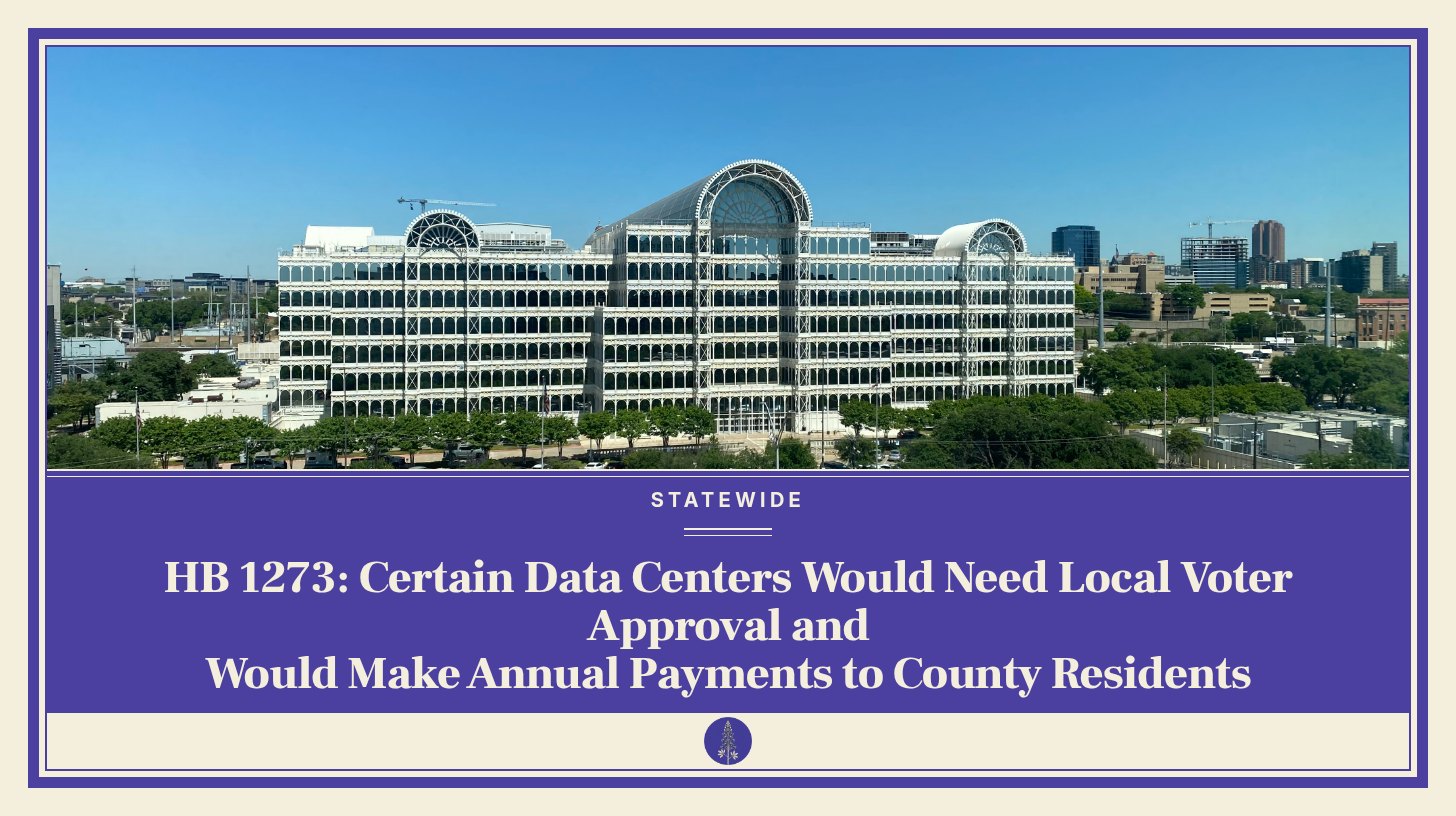
Header photo: The Infomart, an Equinix data center on North Stemmons Freeway in Dallas, Texas, April 4, 2024. Photo by Andrew nyr, CC BY-SA 4.0, via Wikimedia Commons.
Sources
- HB 1273 bill history, 90th Legislature
- HB 1273 bill text, as filed
- HB 1273 authors
- Rep. Don McLaughlin, House District 80
- Texas Secretary of State election results, Nov. 3, 2026 general election
- Government Code Section 301.001 (session start)
- HB 1225: Data Center Tax Abatements Would Face a Property Value Cap
- TCEQ Data Center Permit Pause Tied to ERCOT Community Impact Review