The Texas Animal Health Commission set up three new New World screwworm infested zones on Nov. 13. Each executive director order followed a detection the day before. The orders cite a bovine in Jim Hogg County, a bovine in La Salle County and a horse in Goliad County, all detected Nov. 12.
On Nov. 14 the commission signed a modified order for Brewster and Terrell counties after two sheep were detected in Terrell County on Nov. 13. A bovine had been detected in that county on Nov. 11, according to the order.
The New Orders
Infested Zone 34 covers parts of Brooks, Jim Hogg and Starr counties. It followed the Nov. 12 detection in a bovine in Jim Hogg County.
Infested Zone 35 covers parts of Dimmit, Frio, La Salle and Zavala counties. It followed the Nov. 12 detection in a bovine in La Salle County.
Infested Zone 36 covers parts of Goliad County. It followed the Nov. 12 detection in a horse.
Infested Zone 33.A covers parts of Brewster and Terrell counties. It replaced Zone 33, which a Nov. 12 order set up after the Nov. 11 detection in Terrell County.
Where the Restrictions Apply
The commission’s public notice says movement restrictions are in place in parts of 31 Texas counties. Each order draws a zone around a detection, so the rules apply only inside those zones and not to every acre of a listed county. Grouped by The Bluebonnet Express regions, the counties are:
West Texas: Brewster, Culberson, El Paso, Fisher, Hudspeth, Irion, Jeff Davis, Mitchell, Nolan, Pecos, Presidio, Reagan, Reeves, Scurry and Terrell
Hill Country: Bandera, Crockett, Edwards, Schleicher, Sutton and Val Verde
South Texas: Brooks, Goliad, Jim Hogg and Zapata
Southwest Texas: Dimmit, Frio, La Salle, Medina and Zavala
Rio Grande Valley: Starr
What the Orders Require
Warm-blooded animals in an infested zone may not leave the zone without prior authorization from the commission, according to the notice. Animals moving out have to be inspected by the commission or a certified New World screwworm inspector. The inspector fills out a movement and treatment certificate that lists the product used and each animal’s official identification, and the certificate travels with the animals.
The orders say hides, carcasses and parts of any animal that could host the pest have to be inspected, and treated if a commission representative deems it necessary, before they leave the zone. They say unauthorized movement is subject to administrative penalties or criminal prosecution.
The Case Count
The commission reports confirmed detections in 25 Texas counties during the 2026 outbreak and at least one confirmed detection at 77 premises. The first Texas case was confirmed June 3, 2026, in a calf in Zavala County. The commission says that calf recovered.
State Disaster Proclamations
The Nov. 13 orders say Gov. Greg Abbott issued a statewide disaster proclamation on Jan. 29, 2026, because of the threat the pest poses to the livestock industry, and has renewed it each month. After the first Texas detection, Abbott issued a new statewide proclamation on June 5, 2026. The orders say he renewed it on July 4, Aug. 3, Sept. 2, Oct. 2 and Nov. 1.
The Pest and the Response
New World screwworms are the larvae of the screwworm fly, Cochliomyia hominivorax. The flies lay eggs in open wounds or body openings of live animals, and the larvae burrow into living flesh, the commission says. Other wound flies feed on dead tissue. The pest is identified by collecting and examining larvae.
Sterile fly releases by ground and by air are underway in affected areas, according to the commission. The United States last eradicated the pest in 1966 with the sterile insect technique. Female flies mate once, so matings with sterile males produce eggs that do not hatch, and the population dies off over a few life cycles, the commission says.
How to Report a Case or Move Animals
The commission says inspections for moving animals out of a zone can be scheduled with its deployed inspectors at 512-714-1936, or with a certified inspector from the list on its website. Suspected cases in livestock and pets go to a commission region office or the veterinarian on call at 1-800-550-8242. Suspected cases in wildlife go to the Texas Parks and Wildlife Department at 512-389-4505.
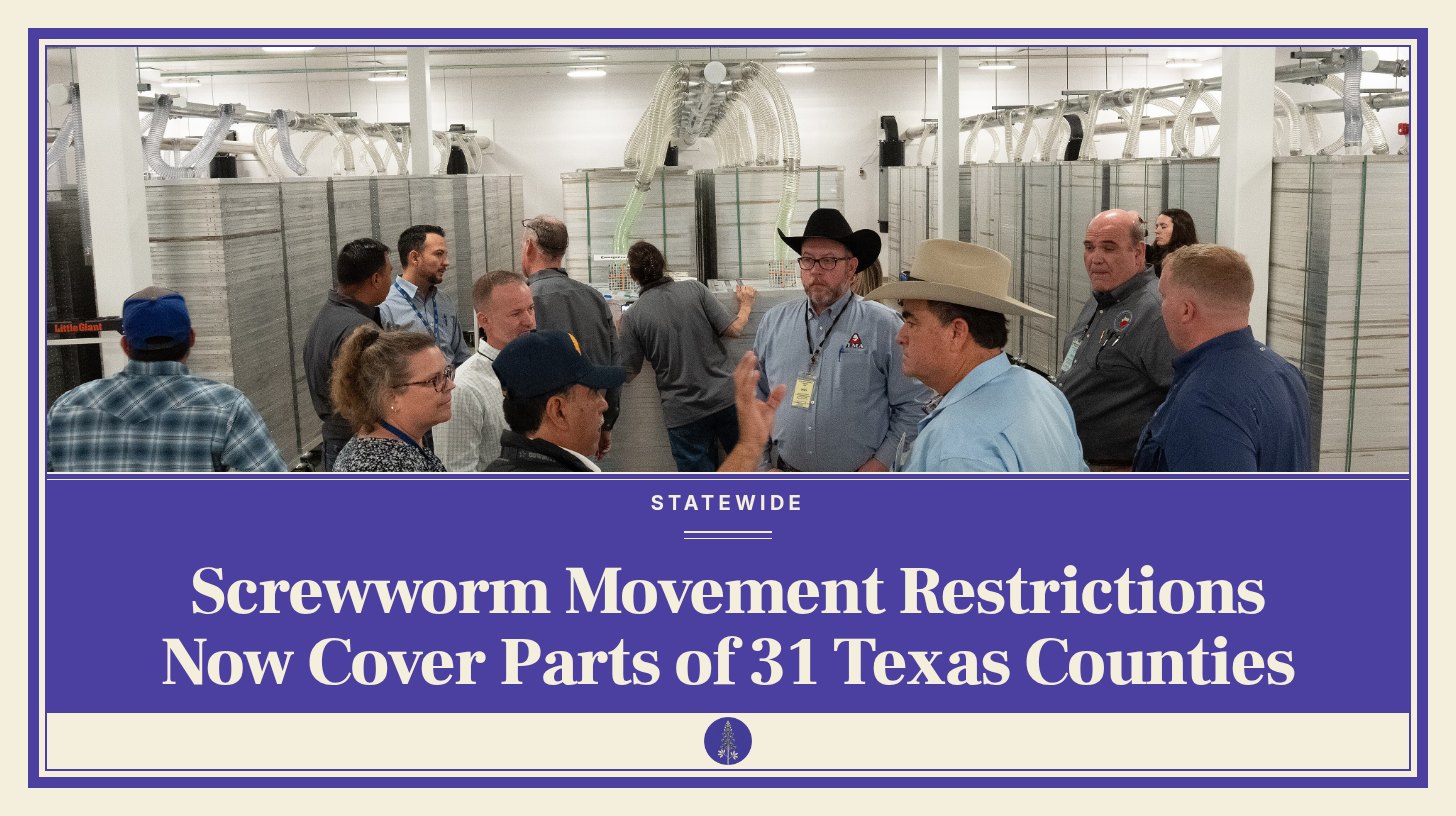
Header photo: Stakeholders tour the New World screwworm sterile fly dispersal facility at Moore Airfield in Edinburg on Feb. 10, 2026. U.S. Department of Agriculture photo, public domain, via Wikimedia Commons.
Sources
Texas Animal Health Commission, New World Screwworm page (county list, case count, inspection and reporting numbers): https://www.tahc.texas.gov/emergency/nws.html
Executive director order, Brooks, Jim Hogg and Starr counties, Nov. 13, 2026: https://www.tahc.texas.gov/regs/pdf/2026-11-13_NWS_EDO_BrooksJimHoggStarr.pdf
Executive director order, Dimmit, Frio, La Salle and Zavala counties, Nov. 13, 2026: https://www.tahc.texas.gov/regs/pdf/2026-11-13_NWS_EDO_DimmitFrioLaSalleZavala.pdf
Executive director order, Goliad County, Nov. 13, 2026: https://www.tahc.texas.gov/regs/pdf/2026-11-13_NWS_EDO_Goliad.pdf
Modified executive director order, Brewster and Terrell counties, Nov. 14, 2026: https://www.tahc.texas.gov/regs/pdf/2026-11-14_NWS_EDO-Modified_BrewsterTerrell.pdf
This story was first published on our Substack.