Rep.-elect Chris Spencer (R) HD-1 filed House Bill 1261 (Texas Legislature Online) on Nov. 20, 2026. The bill may be cited as the Texas Private Property and Public Necessity Protection Act. It would add statewide public necessity standards for eminent domain, including independent review, public hearings, county elections, a compensation floor of 200 percent of fair market value, repurchase rights, and revenue accounting. SECTION 14 says the Act takes effect Jan. 1, 2028, but only if the constitutional amendment proposed by the 90th Legislature, Regular Session, 2027, concerning the public-necessity standard for eminent domain is approved by the voters at the Nov. 2, 2027, election. If that amendment is not approved, the Act has no effect. HB 1261 has been filed and has not become law.
What the Bill Would Change
SECTION 3 would add Subchapter E, Statewide Public Necessity Standards, to Government Code Chapter 2206. Under proposed Section 2206.202, the subchapter would govern every proposed condemnation under state law by a public or private condemnor, regardless of size or location, and would supplement Chapter 21 of the Property Code. The subchapter would apply to transportation, water, wastewater, drainage, ports, public buildings, schools, parks, utilities, transmission, pipelines, storage facilities, and other undertakings alike, but would confer no new condemnation authority.
Proposed Section 2206.201 would define "public necessity" as an objectively demonstrated, immediate and critical need for essential public infrastructure or services directly benefiting the general public, including the local population where a taking occurs, that cannot reasonably be supplied by a feasible, less intrusive alternative. "Immediate" would require a presently established need and an objectively justified implementation schedule; speculative growth projections alone would be insufficient. A "covered project" would mean the entire undertaking for which property acquisition by eminent domain is proposed, including related reservoirs, roads, pipelines, power facilities, transmission lines, mitigation areas, access facilities, storage, development phases, and improvements under common control or coordinated funding. A connected project could not be artificially divided to avoid a statutory requirement.
Proposed Section 2206.204 would require a condemnor, before filing a condemnation petition or threatening involuntary possession, to prove by clear and convincing evidence for each tract and each interest sought that the project meets a present public necessity; that the exact parcel and interest are indispensable to that necessity; that no feasible combination of conservation, design changes, routes, sites, technology, existing property, demand reduction, voluntary acquisition, or a lesser estate can meet the demonstrated need; and that the taking is the least intrusive reasonably feasible means. Greater population, forecast taxes, grants, economic development, or the convenience of the sponsor would not create a presumption. An offer refused by an owner would not be evidence of public necessity.
Proposed Section 2206.203 would prohibit a taking if its primary purpose is speculative population or tax-base growth, private development, private commerce, increased private profit, assembly for resale, or a public-private venture principally supplying private economic return. An entity created to profit from acquiring condemned property, a private for-profit company, or an unelected governing board could not hold or exercise a new state-law delegation of eminent-domain power after the effective date. Only the state or an elected political-subdivision governing body could authorize a taking, and an elected authorizing body would have to consider each affected project and issue written parcel-specific findings.
Proposed Section 2206.205 would require the condemnor, before the public hearing, to submit the complete project and parcel-specific necessity record to an independent three-member review panel appointed by the district court in the county where the property lies from an approved public roster of qualified independent professionals. The panel would have to include one member with relevant engineering or infrastructure expertise; one with land valuation, agricultural, or environmental expertise appropriate to the affected property; and one attorney experienced in property or administrative law or a qualified neutral with judicial experience. The panel would conduct a publicly noticed evidentiary meeting and publish an independently reasoned recommendation within 90 days of a complete submission. The recommendation would be evidence but would not be conclusive and would not replace judicial findings. The condemnor would pay reasonable approved panel costs; affected owners would pay no panel costs.
Proposed Section 2206.206 would require the condemnor, at least 90 days before filing a condemnation petition, to provide each affected owner, county commissioners court, and affected municipality a complete project description and the other records listed in that section, including the independent-review report and parcel-specific necessity findings. The documents would have to be available without charge online and in a physical public location in each affected county. Notice would have to be mailed to affected owners, published in an appropriate newspaper, and posted publicly at least 30 days before a recorded hearing in each affected county.
Proposed Section 2206.207 would require, before a condemnor files the first petition for a covered project that proposes, in aggregate, to acquire through eminent domain more than 100 acres or property of more than 10 separate owners, an affirmative majority vote at a project-specific election in each county in which a project taking would occur. Approval in another county could not substitute. Failure to hold an election would be treated as denial, not deemed approval. For the thresholds, reasonably foreseeable project phases, connected parcels, threatened condemnation acquisitions, common owners, affiliates, and substantially related routes or sites would have to be aggregated. A person owning multiple parcels would be counted once for the separate-owner threshold.
Proposed Section 2206.201 would define "protected land" as prime farmland identified under United States Department of Agriculture soil classifications, active timberland, watershed or recharge land, bottomland hardwood forest, a multigenerational ranch held continuously in family ownership for at least 25 years, or a homestead occupied or qualified for homestead treatment under applicable law. Absence of a tax exemption would not defeat otherwise qualifying land. Under proposed Section 2206.208, protected land could be condemned only on a showing by clear and convincing evidence of unavoidable immediate public necessity for that protected tract, as independently reviewed and judicially determined, and only after at least two-thirds of votes cast on the question by the qualified voters in each county containing affected protected land are in favor. That special election would be required regardless of project acreage or the number of affected owners.
Proposed Section 2206.209 would give the district court where the tract is located original jurisdiction, before appointment of special commissioners under Chapter 21 of the Property Code, to decide lawful authority, public necessity, independent panel compliance, elections, protected status, the validity of a proposed interest, and the absence of feasible alternatives. The condemnor would have to establish each element by clear and convincing evidence. Neither a permit nor a condemnor's own determination would receive deference. No court or special commissioner could permit possession, entry for construction, site disturbance, or transfer of ownership pending a final favorable necessity determination and completion of timely review. Either party could take an interlocutory appeal from the necessity ruling, and a timely appeal would stay all condemnation and possession activity for the affected parcel through resolution of that appeal. An owner who obtains dismissal or an injunction for noncompliance, or whose condemnor voluntarily dismisses after a substantial contest to necessity, would receive reasonable attorney, expert, appraisal, and court costs.
Proposed Section 2206.210 would set the minimum amount for a taking permitted by the subchapter at 200 percent of the fair market value of the interest condemned as of the valuation date immediately preceding any project-caused diminution, plus independently established severance damages to the remainder and reasonable actual relocation, loss-of-access mitigation, restoration, fencing, drainage, business-interruption, moving, and necessary appraisal, legal, and professional expenses caused by the taking. The condemnor would have to pay or secure the required amount before possession. Tender alone would not authorize possession while necessity remains in litigation.
Proposed Section 2206.211 would give a former owner, or the owner's heirs, successors, or assigns, an enforceable right to repurchase an interest condemned under the subchapter if the property is not actually placed into the original specifically stated public-necessity use within 10 years after acquisition, even if surveying, planning, procurement, financing, permitting, or another preliminary act occurred. The right would also arise earlier upon cancellation, abandonment, disposal, or a change to a substantially different use. The repurchase price would be the original compensation attributable to the interest reacquired, adjusted by the change in the United States Consumer Price Index for All Urban Consumers from acquisition through repurchase. SECTION 8 and SECTION 9 would add Property Code provisions so that those additional repurchase triggers and the Section 2206.211 repurchase price apply to property acquired under the new subchapter.
Proposed Section 2206.212 would require a condemnor, if receipts or revenue are obtained directly from property involuntarily acquired for a covered project, including leases, license fees, royalties, rents, sales, commercial access charges, concessions, or consideration for later transfer or commercial use, to annually account for and remit the attributable revenue in proportion to the real property interests acquired from the affected former owners and successors. Public taxes and general utility tariffs collected for services that cannot reasonably be attributed to the affected parcel would not be treated as property-generated receipts merely because a public facility crosses the parcel.
Proposed Section 2206.213 would require the comptroller to maintain a free statewide registry of covered projects and the other information listed in that section. The attorney general could seek injunctive or declaratory relief to prevent an unauthorized taking. An affected owner could bring an action for declaratory or injunctive relief and enforcement of a mandatory duty in a district court of the county where the land lies.
Proposed Section 2206.214 would allow a district court to authorize only temporary, reasonably necessary access or a nonpermanent property interest for a documented imminent threat to human life when no feasible response exists without immediate access. The order would have to specify maximum duration, safeguards, payment, restoration, and a hearing within 10 days, and would not authorize a permanent taking.
SECTION 4 and SECTION 5 would add Government Code provisions so that an exception or a local ordinance, resolution, or delegation could not dispense with the parcel-specific public necessity findings, independent review, or county election required by Subchapter E. SECTION 6 would add Property Code Section 21.0125, requiring the district court in the county containing the property, before special commissioners are appointed or possession is granted, to make the findings required by Subchapter E when applicable. SECTION 7 would add Property Code Section 21.0431, directing special commissioners and courts to award no less than the compensation required by Section 2206.210 for a taking covered by that subchapter. SECTION 10 says the Subchapter E and Section 21.0125 requirements would apply notwithstanding a conflicting condemnation grant or procedure in listed Transportation Code, Utilities Code, Water Code, Natural Resources Code, Local Government Code, and Education Code provisions, or a special enabling law, subject to the supremacy of controlling federal law.
SECTION 11 would require the comptroller, within 180 days after the Act takes effect, to publish a consolidated list of existing state-law entities claiming condemnation authority and the statutes that confer it, flag private or unelected bodies, and submit to the legislature proposed conforming repeals or limitations. No new prohibited taking could proceed solely because implementing rules have not yet been adopted. The Act would not appropriate funds.
When It Would Apply
SECTION 12 says the Act governs condemnation petitions filed, and new acquisitions by express threat of condemnation initiated, on or after the effective date. It would not reopen final judgments or undo an interest actually and lawfully acquired before that date. A preexisting permit, certificate, plan, or contract would not by itself grandfather a future unfiled condemnation proceeding.
The introduced caption says the measure is contingent in part on a constitutional amendment. SECTION 14, the effective-date provision, says the Act takes effect Jan. 1, 2028, but only if the constitutional amendment proposed by the 90th Legislature, Regular Session, 2027, concerning the public-necessity standard for eminent domain is approved by the voters at the Nov. 2, 2027, election. If that amendment is not approved, the Act has no effect. The companions page says HB 1261 does not have any companions. No joint resolution proposing that amendment is listed there.
Why It Reaches Rural Texas
The proposed standards would apply to every proposed condemnation under state law, regardless of size or location, including projects in unincorporated areas. Protected land, which would be subject to a two-thirds county vote and a higher necessity showing, includes prime farmland, active timberland, watershed or recharge land, bottomland hardwood forest, a ranch held continuously in family ownership for at least 25 years, and a homestead. Covered projects listed in the bill include reservoirs, roads, pipelines, power facilities, and transmission lines. County elections would be required for projects above the acreage or owner thresholds, and for any taking of protected land. Eminent domain and private property rights are standing rural coverage topics.
Where It Stands
HB 1261 has been filed and has not been referred to a committee. No fiscal note is posted yet, and the companions page says the bill does not have any companions. Spencer is the only author listed. The 90th Legislature convenes Jan. 12, 2027.
Spencer is the member-elect for House District 1. The current House member page for that district does not list a sitting member and names Bowie, Cass, Lamar, Morris and Red River as the counties represented.
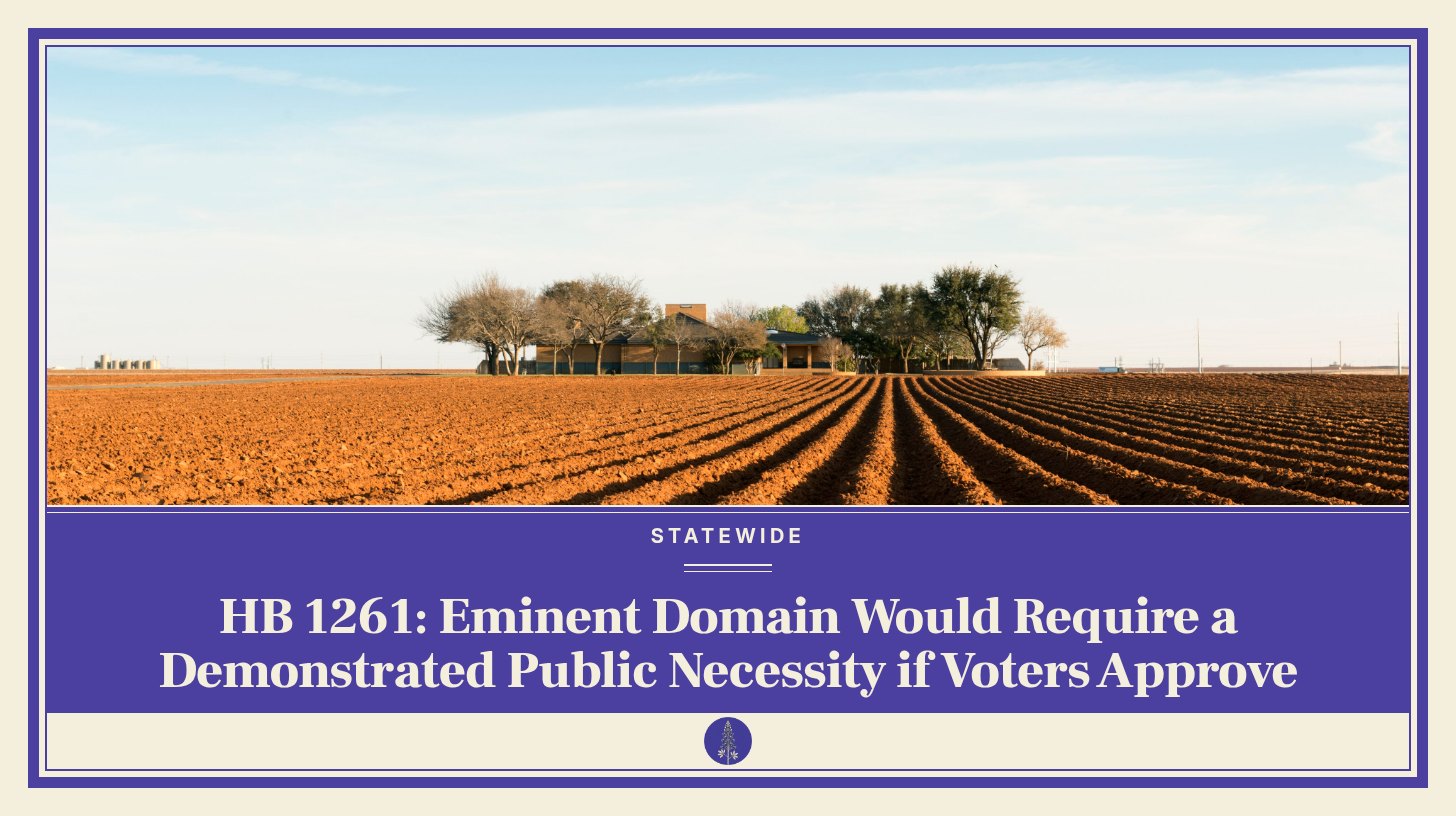
Header photo: Farmland with furrows east of Lamesa in Dawson County, Texas, March 23, 2014. Photo by Carol M. Highsmith, public domain, via the Library of Congress and Wikimedia Commons.